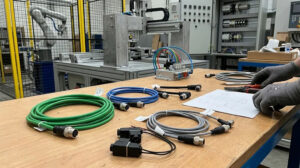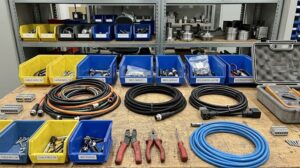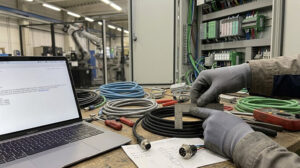
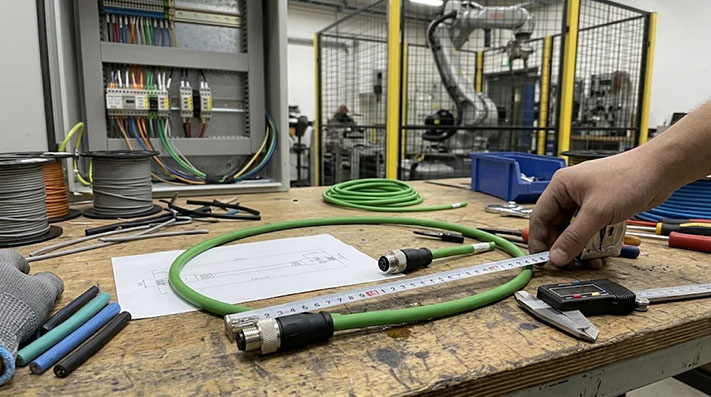
You have a new machine design or an old one that needs a cable upgrade[cite: 14]. An off-the-shelf M12 Ethernet cable won’t work—it’s the wrong length, the jacket material isn't durable enough for the environment, or you need an M12 connector on one end and unterminated wires on the other[cite: 14]. You need a custom assembly, but you also need an accurate quote without endless back-and-forth emails with a supplier[cite: 14].
To get a fast and precise quote, you need to provide a clear set of specifications[cite: 14]. A complete Request for Quote (RFQ) ensures the supplier understands your exact requirements for performance, installation, and durability[cite: 14].
The Core Specifications for Any M12 Ethernet Cable RFQ
A manufacturer can provide a preliminary quote with just a few details, but for an accurate production quote, more information is needed[cite: 14]. Think of your cable assembly in three parts: Connector A, the cable itself, and Connector B[cite: 14].
1. Connector Configuration (for Each End)
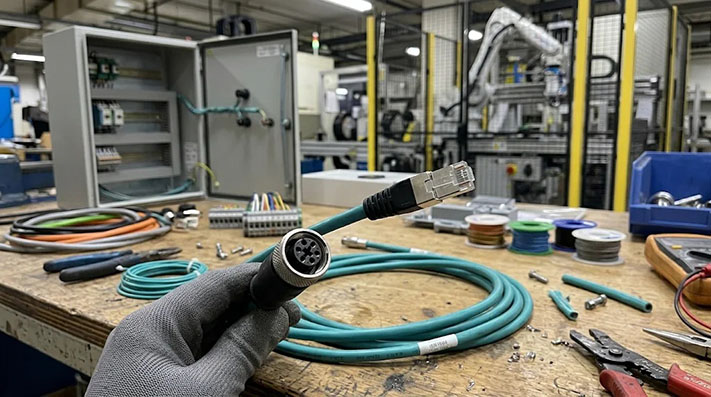
Describe each end of the cable separately[cite: 14]. If both ends are the same, you can simply state "M12 Male to M12 Male," but if they differ, specify each one[cite: 14].
- Connector Family: M12 is the family, but the coding is critical for Ethernet[cite: 14].
- D-Code (4-Pin): Used for Industrial Ethernet and Profinet systems up to 100 Mbps[cite: 14]. Its keyed shape prevents incorrect mating with other M12 codes[cite: 14].
- X-Code (8-Pin): Used for high-speed Industrial Ethernet up to 10 Gbps, suitable for machine vision and other data-intensive applications[cite: 14]. The 'X' shaped shielding within the connector isolates the twisted pairs, ensuring signal integrity[cite: 14].
- Gender: Is the connector Male (with pins) or Female (with sockets)[cite: 14]?
- Angle: Do you need a Straight or Right-Angle connector[cite: 14]? Right-angle connectors are essential for installations with limited clearance, preventing sharp cable bends that can damage conductors and degrade signal performance[cite: 14].
- Termination Type: If one end is not an M12 connector, what is it[cite: 14]?
- RJ45: A common choice for connecting to control cabinets or network switches[cite: 14].
- Unterminated (Flying Leads): The cable ends in bare wires for direct connection to terminal blocks or other components[cite: 14]. If you choose this, specify the required strip length for the outer jacket and the inner conductors[cite: 14].
 [cite: 14]
2. Cable Specifications
The cable that connects your two ends determines the assembly's performance and durability[cite: 14].
- Length: Provide the exact length from end to end[cite: 14]. Be sure to specify the unit (meters or feet) and any required tolerance (e.g., 5 meters +/- 50mm)[cite: 14].
- Jacket Material: This choice depends entirely on your operating environment[cite: 14].
- PVC (Polyvinyl Chloride): A general-purpose, cost-effective material suitable for static installations with minimal exposure to oils or harsh chemicals[cite: 14].
- PUR (Polyurethane): A highly durable material ideal for applications involving motion (robotics, drag chains), abrasion, and exposure to industrial oils and chemicals[cite: 14].
- Shielding: Shielding protects your data signal from electromagnetic interference (EMI), which is common in factories with motors, drives, and high-power equipment[cite: 14].
- Shielded (FTP/SFTP): Most industrial Ethernet applications require shielding[cite: 14]. A foil or braid shield (or both) grounds electrical noise, preventing data loss[cite: 14]. Specify if you need a particular shield type[cite: 14].
- Unshielded (UTP): Only suitable for environments with very low electrical noise, which is rare in industrial settings[cite: 14].
Electromagnetic Interference (EMI) Shielding Topology & Transfer Impedance Matrix
Specifying the correct shielding architecture in your custom cable RFQ guarantees immunity against high-frequency drive noise:
| Factory EMI Environment & Noise Source | Recommended Shielding Construction | Optical Braid Coverage (%) | Transfer Impedance ($Z_t$ at 10 MHz) | Primary Engineering Risk if Mismatched |
|---|---|---|---|---|
| Clean Control Cabinet (Low EMI) | UTP (Unshielded) or Foil-Only | 0% to 100% Foil | Greater than 50 m-ohms / m | Packet loss if exposed to external transients. |
| Standard Industrial Cell (Conveyors) | F/UTP (Overall Foil Shield) | 100% Foil Coverage | ~20 m-ohms / m to 50 m-ohms / m | Moderate data corruption near small motors. |
| Heavy Industrial (Near VFD Drives) | SF/UTP (Overall Foil + Braid) | Greater than or equal to 85% Braid | Less than or equal to 10 m-ohms / m | Inverter high-frequency noise causes PLC disconnects. |
| Critical Servo / Robot Cell (10G Link) | S/FTP (Individual Pair Foil + Braid) | Greater than or equal to 90% Braid | Less than or equal to 3 m-ohms / m (Ultra-Low) | Cross-pair crosstalk and severe frame dropping. |
- Conductor Size: Measured in American Wire Gauge (AWG), this affects the cable's electrical properties and performance over distance[cite: 14]. Common sizes for M12 Ethernet cables are 26, 24, or 22 AWG[cite: 14]. If you are unsure, provide your data rate and maximum cable run length, and the supplier can recommend an appropriate gauge[cite: 14].
Custom Ethernet Assembly: High-Frequency Electrical Specification Matrix
When issuing an RFQ for custom M12 Ethernet assemblies, specifying precise transmission limits ensures the delivered cable meets application bandwidth demands:
| Electrical / Transmission Metric | D-Code Custom Assembly (100 Mbps) | X-Code Custom Assembly (1 Gbps – 10 Gbps) | Engineering Standard & Testing Method |
|---|---|---|---|
| Max Transmission Bandwidth | 100 MHz (Cat5e Performance Level) | Up to 500 MHz (Cat6A Performance Level) | ISO/IEC 11801 Class D vs. Class EA |
| Differential Characteristic Impedance | 100 ohms ± 15% (at 100 MHz) | 100 ohms ± 5% (Precision Toleranced) | TIA-568-C.2 Component Specification |
| Near-End Crosstalk (NEXT) at 100MHz | Greater than or equal to 30.1 dB isolation | Greater than or equal to 44.3 dB isolation | IEC 60603-7 Modular Plug Specification |
| Return Loss (RL) Performance | Min 10.0 dB (Adequate for Fast Ethernet) | Min 17.3 dB (Minimal signal reflection) | IEC 60603-7-41 / -51 |
3. Application and Quantity Details
Context helps a supplier identify potential issues before production[cite: 14].
- Application Environment: Where and how will the cable be used[cite: 14]? Be specific[cite: 14].
- Static machine wiring[cite: 14]?
- Robotic arm with constant twisting and bending (high-flex)[cite: 14]?
- Drag chain (C-track) with linear flexing[cite: 14]?
- Washdown area with high-pressure spray[cite: 14]?
- Outdoor installation with UV exposure[cite: 14]?
Dynamic Mechanical Motion Profile & Fatigue Endurance Limits for Custom RFQs
Defining the exact mechanical motion profile in your RFQ ensures the manufacturer selects the proper conductor stranding and jacket compounding:
| Application Motion Environment | Recommended Jacket Material | Conductor Stranding Profile | Min. Dynamic Bend Radius | Tested Drag Chain Flex Cycles |
|---|---|---|---|---|
| Static Cabinet Routing / Fixed | PVC (Cost-Optimized) | Solid or Standard Stranded (Class 2/5) | 5 x Outer Diameter (OD) | N/A (Fixed Static Installation) |
| Linear Gantry / Axis Slide | PUR (Polyurethane) | Fine Stranded Copper | 7.5 x OD | Greater than 1,000,000 Cycles |
| High-Speed Servo Drag Chain | PUR (High-Flex Compound) | Extra-Fine Bundled Strands | 10 x OD | Greater than 5,000,000 to 10,000,000 Cycles |
| 3D Articulated Robotic Arm (Axis 1–6) | TPE (Thermoplastic Elastomer) | Special Torsional Strain-Relief Strands | 12 x OD | Greater than 3,000,000 (plus/minus 360 deg/m) |
- Required Standards: Does the final machine need to meet certain market standards[cite: 14]? If your equipment is destined for North America, you may need components that are UL Recognized or UL Listed[cite: 14]. If you require RoHS compliance or specific protocol certifications, state this in the RFQ[cite: 14].
- Quantity and Timeline: Specify the quantity needed for prototypes and the expected annual production volume[cite: 14]. This affects pricing and production planning[cite: 14]. Include your target date for receiving the first articles or production run[cite: 14].
A Practical RFQ Checklist
To make the process easier, use this checklist when preparing your request[cite: 14]. Filling this out and sending it with a drawing or photo is the fastest way to get an accurate quote[cite: 14].
Project Information
- Project Name/Number:
- Company:
- Contact Person:
- Target Date for Quote:
Cable Assembly Specifications
- Connector A:
- Type: M12 or other (e.g., RJ45)
- Coding: X-Code or D-Code
- Gender: Male or Female
- Angle: Straight or Right-Angle
- Connector B:
- Type: M12 or other (e.g., Unterminated)
- Coding: X-Code or D-Code
- Gender: Male or Female
- Angle: Straight or Right-Angle
- Cable:
- Length & Tolerance:
- Jacket Material: PVC, PUR, or other
- Shielding: Yes/No
- Color:
- Technical Requirements:
- Application (Static, Flexing, Torsion, Drag Chain):
- Required Standards (UL, RoHS, etc.):
- Data Rate Requirement:
- Logistics:
- Prototype Quantity:
- Production Quantity (Annual Estimate):
- Target Delivery Date:
- Attachments: (Provide drawing, photo, or existing part number if available)
Get Help Finalizing Your Specifications
This list may seem detailed, but providing these specifications upfront prevents misquotes and production delays[cite: 14]. A clear RFQ allows the supplier to check for potential design conflicts, suggest improvements, and quote the right components for your machine[cite: 14].
If you are missing some of this information, don't worry[cite: 14]. A good supplier can help you fill in the blanks[cite: 14]. At ConnecLink, our team is experienced in defining cable assemblies for industrial automation[cite: 14]. Send us your RFQ with the details you have—even if it's just a basic drawing or a photo of a cable you need to replace[cite: 14]. We will work with you to confirm the remaining specifications and ensure the final product meets your exact needs[cite: 14].
<!--[googlesitekit-end-of-content]-->