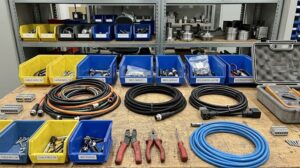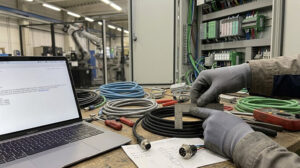
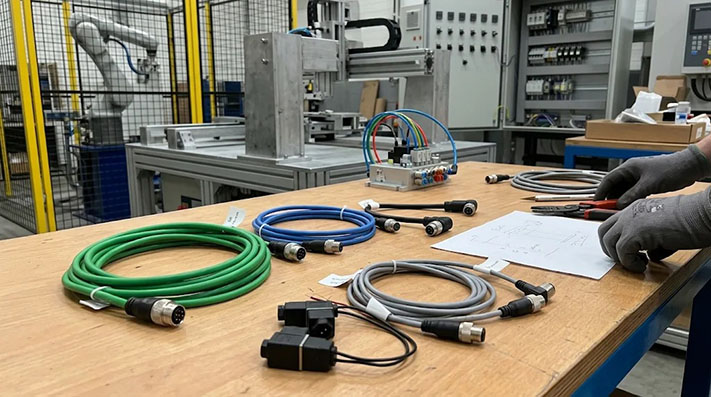
For an equipment OEM, the prototype phase is critical[cite: 15]. You need just a handful of specific cables to validate a new machine design[cite: 15]. For a system integrator, a project may only require a small, mixed set of connectors for a one-off installation[cite: 15]. In both cases, sourcing high-performance industrial connectors like M12 Ethernet cables can be frustrating when faced with high Minimum Order Quantities (MOQs) from large manufacturers or distributors[cite: 15].
The good news is that you have options[cite: 15]. Finding a supplier structured to handle prototype, low-volume, and mixed-product orders is key[cite: 15]. This approach allows you to get the exact M12 D-Code or X-Code assemblies you need for testing and small production runs without being forced to purchase hundreds of units[cite: 15].
MOQ Considerations: Standard vs. Custom M12 Assemblies
The primary factor influencing order quantity is the difference between a standard product and a custom one[cite: 15]. Understanding this distinction is the first step in developing a sourcing strategy[cite: 15].
Standard, Off-the-Shelf Cables
A "standard" cable assembly is one with a common, high-demand configuration[cite: 15]. For M12 Industrial Ethernet, this might include[cite: 15]:
- Coding: D-Code (4-pin, 100 Mbps) or X-Code (8-pin, 10 Gbps)[cite: 15]
- Configuration: Male-to-female or male-to-open-leads[cite: 15]
- Orientation: Straight connectors on both ends[cite: 15]
- Length: Common lengths like 1, 2, 3, or 5 meters[cite: 15]
- Jacket: General-purpose PVC[cite: 15]
Because these configurations are produced more frequently, suppliers are more likely to have them available for smaller orders[cite: 15]. However, even "standard" items can be subject to MOQs if the supplier's business model is built exclusively for high-volume production[cite: 15].
Custom Cable Assemblies
An assembly becomes "custom" when it deviates from standard stock[cite: 15]. Customization introduces unique production steps, material requirements, and engineering oversight, which is why it often comes with higher MOQs[cite: 15].
Examples of custom features include[cite: 15]:
- Specific Lengths: A precise length like 1.35 meters to fit a machine's geometry[cite: 15].
- Connector Mix: An M12 X-Code connector on one end and an RJ45 on the other[cite: 15].
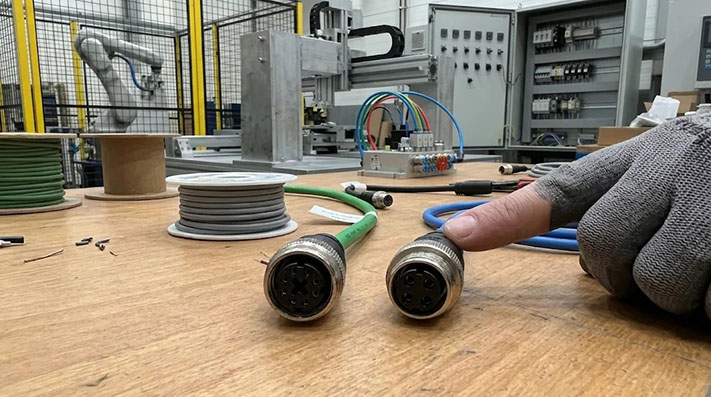
- Right-Angle Connectors: One or both ends requiring a 90-degree connector to manage cable routing in tight spaces[cite: 15].
- Specialized Materials: A PUR jacket for high-flex or oil-resistant applications, or specific shielding for high-EMI environments[cite: 15].
- Branching: A Y-splitter or other multi-branch harness configuration[cite: 15].
While custom assemblies are more challenging to source in small numbers, it is not impossible[cite: 15]. The key is to work with a supplier that has flexible production lines designed to accommodate both prototype and volume orders[cite: 15].
Prototyping Sourcing Parameters: Standard Off-the-Shelf vs. Custom Engineered M12 Assemblies
Evaluating minimum order quantities (MOQs) against production lead times and performance flexibility optimizes the OEM prototype development cycle:
| Sourcing & Engineering Parameter | Standard Off-the-Shelf M12 Assemblies | Custom-Built M12 Cable Assemblies | Engineering & Sourcing Impact |
|---|---|---|---|
| Minimum Order Quantity (MOQ) | Typically 1 to 5 pcs (In-stock distribution) | Flexible / Low-Batch (10 to 50 pcs for prototypes) | Eliminates high-volume capital lockup during R&D. |
| Production & Delivery Lead Time | 2 to 5 Business Days (Ex-stock) | 10 to 15 Business Days (Custom production) | Accommodates fast-track machine iteration schedules. |
| Transmission Bandwidth & Coding | Fixed (Standard D-Code or X-Code) | Customized (Specific AWG, Shielding, Pinout) | Matches exact physical layer requirements of new drives. |
| Jacket Material & Mechanical Specs | Standard PVC or basic PUR | Advanced PUR / TPE High-Flex Compounds | Tailored precisely to the machine's operating environment. |
 [cite: 15]
Prototyping and Small-Project Sourcing Strategies
If you are an OEM building a prototype or an integrator with a specialized project, a rigid, high-volume supply chain is a barrier[cite: 15]. Here are effective strategies for securing the M12 Ethernet cables you need[cite: 15].
1. Identify Suppliers That Explicitly Welcome Prototype Inquiries
Some connector and cable assembly suppliers build their business around serving the OEM and system integrator market[cite: 15]. Their processes are designed to handle inquiries for quantities ranging from single digits for prototypes to thousands for full production[cite: 15]. They understand that a successful prototype order often leads to a larger production order later[cite: 15].
2. Leverage a Supplier's Full Product Family
A supplier with a focused catalog offers a distinct advantage for small, mixed orders[cite: 15]. For example, your project might need[cite: 15]:
- Three M12 X-Code Gigabit Ethernet cables for machine vision cameras[cite: 15].
- Five M8 sensor cables for proximity switches[cite: 15].
- Two solenoid valve connectors for a pneumatic manifold[cite: 15].
Finding a single supplier who can fulfill this entire bill of materials (BOM) in one consolidated order is far more efficient than managing three separate orders, each potentially with its own MOQ[cite: 15]. This "one-stop" approach saves administrative time and can make a small total order viable for the supplier[cite: 15].
3. Prepare a Clear and Complete RFQ
Electromagnetic Interference (EMI) Shielding Topology & Transfer Impedance for Prototype RFQs
Specifying the appropriate shielding architecture in your prototype BOM guarantees signal integrity during initial lab and factory testing:
| Factory EMI Environment & Noise Source | Recommended Shielding Construction | Optical Braid Coverage (%) | Transfer Impedance ($Z_t$ at 10 MHz) | Prototype Testing Risk if Mismatched |
|---|---|---|---|---|
| Clean Lab / R&D Test Bench | UTP (Unshielded) or Foil-Only | 0% to 100% Foil | Greater than 50 m-ohms / m | Unstable communication if tested near factory machinery. |
| Standard Machine Cell (Conveyors) | F/UTP (Overall Foil Shield) | 100% Foil Coverage | ~20 m-ohms / m to 50 m-ohms / m | Minor packet drops near small auxiliary motors. |
| Heavy Industrial / Near VFD Drives | SF/UTP (Overall Foil + Braid) | Greater than or equal to 85% Braid | Less than or equal to 10 m-ohms / m | Inverter noise causes intermittent PLC disconnects. |
| Critical Servo / Robot Cell (10G Link) | S/FTP (Individual Pair Foil + Braid) | Greater than or equal to 90% Braid | Less than or equal to 3 m-ohms / m (Ultra-Low) | Severe crosstalk and frame dropping during fast moves. |
When you request a quote for a small or custom batch, providing clear information is essential[cite: 15]. A well-documented RFQ helps the supplier's engineering team quickly understand your needs and determine feasibility[cite: 15]. Your request should include[cite: 15]:
- Connector A and Connector B: Specify coding (e.g., M12 X-Code), gender (male/female), and orientation (straight/right-angle) for both ends[cite: 15].
- Cable Length: Provide the exact length required[cite: 15].
- Tail Treatment: If one end is unterminated, specify the strip and tin requirements[cite: 15].
- Application Details: Briefly describe the machine, installation environment (e.g., static, constant motion, oil exposure), and data rate requirements[cite: 15].
- Drawings or Photos: A simple drawing, sketch, or even a photo of a comparable cable from an existing machine can eliminate ambiguity[cite: 15].
- Quantity: Be upfront about your prototype or small-batch quantity needs[cite: 15].
Prototype Mechanical Motion Profile & Drag Chain Endurance Specifications
Defining exact operational kinematics during the prototype phase ensures test assemblies survive rigorous machine validation:
| Prototype Application Environment | Recommended Jacket Compound | Conductor Stranding Construction | Min. Dynamic Bend Radius | Tested Drag Chain Flex Cycles |
|---|---|---|---|---|
| Static Panel / Cabinet Testing | PVC (Cost-Optimized R&D) | Stranded Copper (Class 5) | 5 x Outer Diameter (OD) | N/A (Fixed Stationary Test) |
| Linear Gantry / Test Fixture Slide | PUR (Polyurethane) | Fine Stranded Copper | 7.5 x OD | Greater than 1,000,000 Cycles |
| High-Speed Servo Axis Prototype | PUR (High-Flex R&D Grade) | Extra-Fine Bundled Strands | 10 x OD | Greater than 5,000,000 to 10,000,000 Cycles |
| 3D Robotic Articulated Arm (Axis 1–6) | TPE (Thermoplastic Elastomer) | Special Torsional Strain-Relief Strands | 12 x OD | Greater than 3,000,000 (plus/minus 360 deg/m) |
This level of detail signals a serious engineering requirement and enables the supplier to provide an accurate response quickly, even for a small number of assemblies[cite: 15].
A Flexible Partner for Your M12 Cable Needs
For equipment builders and system integrators, sourcing is about more than just finding a part number in a catalog[cite: 15]. It's about finding a partner who understands your design, prototype, and production cycles[cite: 15]. The right supplier recognizes that today's five-piece prototype order is the foundation for tomorrow's five-hundred-piece production run[cite: 15].
ConnecLink is structured to support the needs of automation OEMs, integrators, and MRO teams[cite: 15]. We welcome inquiries for prototypes, low-volume production, and mixed-product orders across our M12, M8, and solenoid valve connector families[cite: 15]. Our unified RFQ process ensures that every request, regardless of quantity, is reviewed by our team to determine the best possible configuration and sourcing solution[cite: 15].
If you are struggling to find a supplier for your small-batch M12 Industrial Ethernet cable needs, tell us about your project[cite: 15]. Provide us with your specifications, drawings, or application details, and let us help you build your next machine[cite: 15].
<!--[googlesitekit-end-of-content]-->