
Sourcing custom M12 cable assemblies should not require weeks of back-and-forth clarification emails. When an engineering or procurement team submits an incomplete drawing or a vague inquiry like "M12 4-pin cable, 2 meters," production delays are almost guaranteed.
To build an accurate quote and avoid assembly errors, an industrial cable manufacturer needs specific, unambiguous parameters. This guide outlines the exact technical data your supplier requires to build your M12 harness correctly on the first run.
Connector Gender and Coding on Both Ends (It's Rarely the Same)
An M12 connector is defined by more than just its thread. You must specify the gender, pin count, and keyway coding for both End A and End B. Assuming the cable is "standard" or that both ends are identical is a common point of failure.
M12 Coding Types
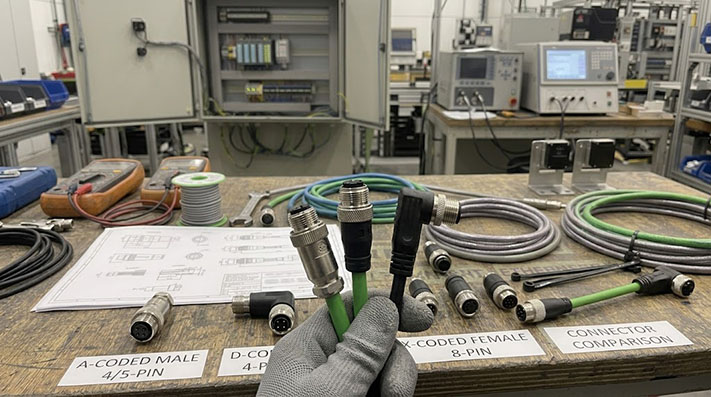
M12 connectors use physical keying (coding) to prevent incorrect mating in the field. The most common types include:
- A-Coded: Typically used for standard sensors, actuators, and low-voltage DC power (3 to 12 pins).
- D-Coded: Used for Industrial Ethernet data transmission (typically 4-pin, up to 100 Mbps).
- X-Coded: Used for high-speed Gigabit Ethernet (8-pin, up to 10 Gbps) with internal shielding splitters.
- Power Codings (S, T, K, L): Used for AC or DC power transmission to motors and auxiliary devices.
Common Specification Mistakes
- Omitting Keyway Coding: Specifying "M12 4-pin" without stating if it is A-coded (sensor) or D-coded (Ethernet). These will not mate with each other.
- Ignoring Connector Orientation: Not specifying whether the connector head is straight or right-angle ($90^circ$). If right-angle, the orientation of the keyway relative to the cable exit must be defined (e.g., keyway up, down, left, or right).
- Unspecified End B Treatment: Leaving the second end of the cable undefined. Specify if End B is an identical M12 connector, a different standard (such as an RJ45, M8, or Solenoid Valve connector), or simply "flying leads" (stripped and tinned wires for terminal block termination).
Cable Jacket Material: PVC vs. PUR vs. TPE for Your Environment
Selecting the wrong outer jacket material can cause premature cable failure, shield degradation, or physical splitting in the field. Your spec sheet must match the operating environment.
| Jacket Material | Best Application Environments | Key Properties | Common Risks / Misuses |
|---|---|---|---|
| PVC (Polyvinyl Chloride) | Static installations, control cabinets, dry environment conveyor lines. | Cost-effective, easy to strip, resistant to basic cleaning agents. | Splits or cracks in continuous flexing (drag chain) applications or low temperatures. |
| PUR (Polyurethane) | Machine tools, automotive assembly lines, robotic cells. | High abrasion resistance, excellent resistance to industrial cutting oils, coolants, and mechanical stress. | Higher material cost; unnecessary for simple, static indoor sensor hookups. |
| TPE (Thermoplastic Elastomer) | Extreme temperatures, outdoor exposure, continuous flex drag chains, welding environments. | Excellent UV resistance, highly flexible at low temperatures, weld-slag resistant. | Over-specifying TPE for static indoor applications drives up unit costs needlessly. |
If your system uses a drag chain or a multi-axis robotic arm, you must also specify the required flex life cycle (e.g., 5 million bending cycles) and the minimum bend radius (e.g., $10 times text{cable outer diameter}$).
Length Tolerance: Why "1 Meter" Can Mean Different Things
A drawing that lists "Length: 1m" without a tolerance specification invites assembly issues. In manufacturing, cable cutting and overmolding are subject to physical variances.
Defining the "L" Dimension
Clearly state how you measure the cable length. The standard industrial practice is to measure face-to-face for molded connector heads, or tip-to-tip for assemblies with flying leads.