
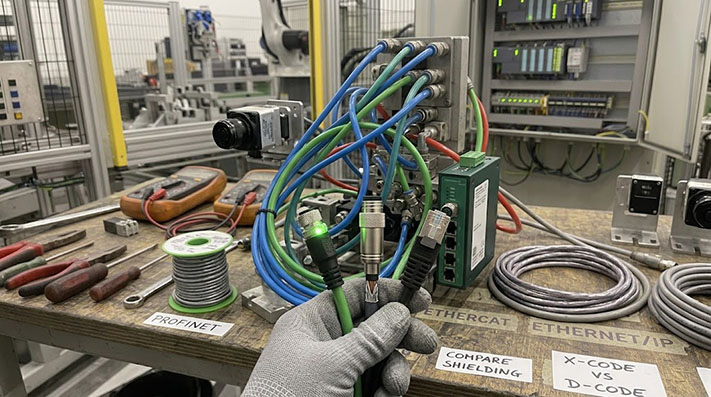
System integrators designing industrial networks cannot treat "Ethernet" as a single, uniform standard. While PROFINET, EtherCAT, and EtherNet/IP all transmit data over Ethernet-based physical layers, their network architectures, hardware requirements, and environmental tolerances dictate different cable selection criteria. Selecting the wrong cable type, conductor gauge, or connector shielding can lead to packet loss, cycle-time jitter, or rapid physical degradation under mechanical stress.
This guide details the physical layer specifications, shielding necessities, speed thresholds, and post-installation testing parameters required to build a reliable industrial network.
Physical Layer Requirements Side-by-Side
The following table summarizes the minimum physical cable specifications required by each of the three major industrial Ethernet protocols.
| Specification Parameter | PROFINET (RT / IRT) | EtherCAT | EtherNet/IP |
|---|---|---|---|
| Standard Speed | 100 Mbps (Fast Ethernet); Gigabit variants available | 100 Mbps (Fast Ethernet); EtherCAT G supports 1 Gbps | 10/100 Mbps; Gigabit common in high-density I/O |
| Minimum Cable Category | Cat5e (Symmetric, 100 $Omega$) | Cat5 or Cat5e | Cat5e, Cat6, or Cat6a |
| Conductor/Pair Count | 2-Pair (4-wire) standard; 4-Pair (8-wire) for Gigabit | 2-Pair (4-wire) standard; 4-Pair for EtherCAT G | 2-Pair (4-wire) or 4-Pair (8-wire) configurations |
| Standard Connector Types | M12 D-Code (4-pin), M12 X-Code (8-pin), RJ45 | M8 (4-pin), M12 D-Code (4-pin), RJ45 | M12 D-Code (4-pin), M12 X-Code (8-pin), RJ45 |
| Cable Classifications | Type A (Fixed), Type B (Flexible), Type C (Trailing/Dynamic) | Fixed, Flexible, and Dynamic (depending on application) | Compliant with TIA-568-C.2 and ODVA industrial standards |
| Typical Shielding | SF/UTP or S/FTP (mandatory) | SF/UTP, S/UTP, or S/FTP | SF/UTP or S/FTP (highly recommended in high-EMI zones) |
Why "Ethernet Cable" Is Not Enough — Industrial Grades Explained
Standard commercial patch cords (such as Cat6 PVC cables used in office environments) are highly susceptible to failure on the factory floor. Industrial environments introduce mechanical, chemical, and electromagnetic stressors that demand specialized cable construction.
Connector Integrity: M12 vs. RJ45
While RJ45 connectors are acceptable inside control cabinets, they lack the ingress protection and vibration resistance needed on the plant floor.
- M12 D-Code (4-Pin): The standard choice for 100 Mbps networks. It carries two transmit/receive pairs, satisfying the base requirements for PROFINET and standard EtherCAT.
- M12 X-Code (8-Pin): Engineered for high-bandwidth applications up to 10 Gbps. It isolates all four pairs with an internal X-shaped metal cross-shield to eliminate internal crosstalk, making it ideal for Gigabit Ethernet and high-speed motion control.
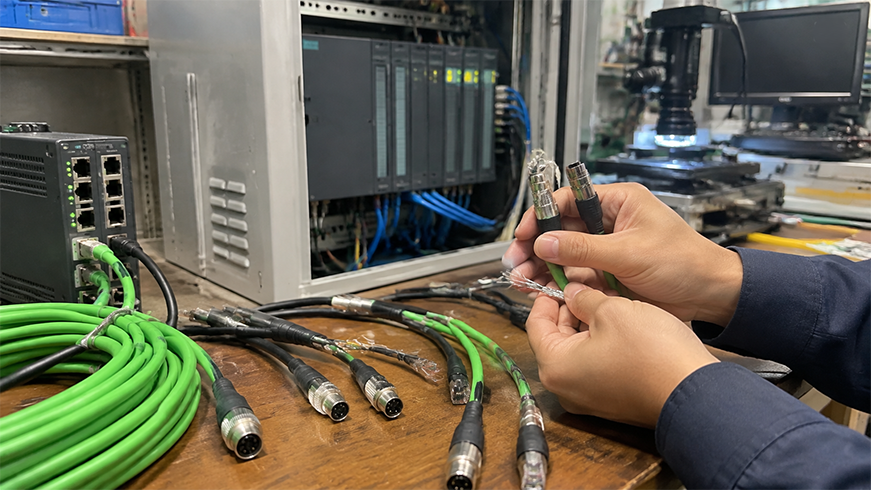
Jacket Material Selection
The outer jacket must match the environmental hazards of the specific machine zone:
- Polyurethane (PUR): Offers high resistance to cutting fluids, mineral oils, abrasion, and continuous flexing. This is the default choice for robotic arms and drag chains.
- Polyvinyl Chloride (PVC): Cost-effective and highly resistant to acids and bases, but can become brittle under constant flexing or exposure to certain industrial oils.
- Thermoplastic Elastomer (TPE): Provides excellent flexibility and resistance to welding splatter, extreme temperatures, and chemical exposure.
Shielding Architecture
Unshielded Twisted Pair (UTP) cables are vulnerable to electromagnetic interference (EMI) from variable frequency drives (VFDs), servo motors, and welding equipment. Industrial Ethernet cables utilize dual-layer shielding:
- Foil Shielding (FTP): Protects against high-frequency electromagnetic noise.
- Braid Shielding (STP): Provides mechanical strength and low-frequency electrostatic shielding.
- SF/UTP (Screened Shielded Twisted Pair): Combines an overall braid screen and an overall foil shield around unshielded twisted pairs to maximize noise rejection.
Protocol Speed Demands and Minimum Cable Specs
PROFINET: The Type A, B, and C Classifications
PROFINET structures its physical cable requirements around the mechanical installation type rather than speed alone:
- Type A (Fixed Installation): Designed for permanent routing in cable trays or conduits. These cables utilize solid copper conductors (typically 22 AWG) to minimize signal attenuation over long runs.
- Type B (Flexible Installation): Built for installations subject to occasional movement, vibration, or bending. They utilize stranded copper conductors, allowing them to bend without fracturing.
- Type C (Highly Flexible / Dynamic): Engineered for continuous motion, such as drag chains, rotary tables, or robotic joints. These cables feature highly stranded conductors and specialized inner fillers to maintain geometry during millions of flex cycles.
EtherCAT: Low-Latency and Precise Synchronization
EtherCAT relies on "processing on the fly," meaning frames are read and written to as they pass through each node. Because packet delivery timing is calculated in microseconds, signal propagation delay and jitter must be kept to an absolute minimum.
- Low Jitter Requirements: Even minor impedance variations can cause signal reflections, leading to packet re-transmission and synchronization errors.
- Standard 100 Base-TX: EtherCAT primarily uses Fast Ethernet. A high-quality 2-pair, 22 AWG or 24 AWG shielded cable (Cat5e) terminated with M12 D-Code connectors is the standard selection for fieldbus runs. For EtherCAT G, 4-pair Cat6a cables with M12 X-Code connectors are required to support Gigabit speeds.
EtherNet/IP: Standardized Flexibility
EtherNet/IP uses standard IEEE 802.3 Ethernet physical layers and TCP/IP protocols. Because it is highly compatible with standard commercial networking equipment, selection focus shifts to ODVA compliance:
- Conformity Guidelines: ODVA defines specifications for industrial-grade cabling, emphasizing mechanical durability and noise immunity (using the M.I.C.E. guidelines—Mechanical, Ingress, Climatic, Electromagnetic).
- High-Channel Applications: Because EtherNet/IP is frequently deployed alongside heavy commercial IT infrastructure, system integrators often deploy 4-pair Cat6 or Cat6a cabling with M12 X-Code connectors to ensure the physical network can handle both high-density I/O traffic and potential diagnostic video feeds simultaneously.
Copper vs. Fiber: When to Make the Jump
While copper remains the standard for short-to-medium runs between local I/O blocks, fiber optic cabling is necessary under specific factory conditions.