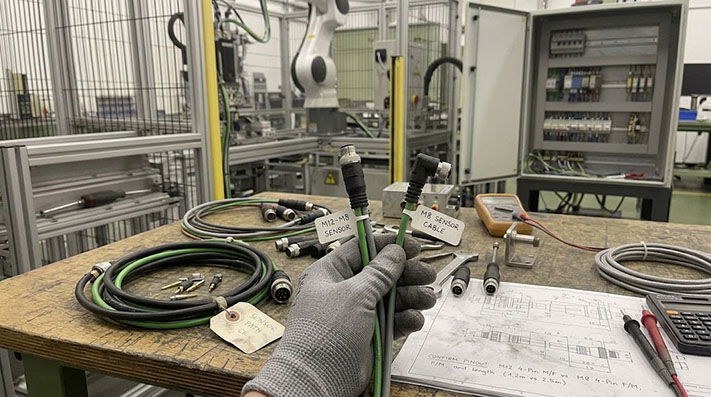
Sourcing custom cable assemblies in small quantities—typically between 10 and 50 pieces—often presents a frustrating hurdle for automation equipment builders, system integrators, and maintenance engineers. You may need a handful of specialized M12-to-M8 double-ended cables for a prototype machine or a short run of M23 servo motor harnesses for a custom robotics cell.
When you submit these low-volume requests, the typical responses from large-scale manufacturers can be discouraging: immediate rejections, high minimum order quantities (MOQs), or unit prices that feel like penalty fees.
Understanding the underlying cost drivers of industrial cable assembly production can help you structure your RFQs to secure competitive pricing, reasonable lead times, and reliable delivery schedules for short-run projects.
Why Some Suppliers Reject Orders Under 100 Pieces
High-volume cable manufacturers build their business models on continuous, automated production runs. For these factories, small-batch orders create operational inefficiencies that disrupt their standard workflow.
1. Setup Time vs. Run Time
Setting up an industrial cable processing line involves stripping machine calibration, terminal applicator adjustment, crimp-force monitor programming, and overmold tooling alignment.
For a 10-piece order, the setup and teardown process can take two to three hours, while the actual assembly run takes less than thirty minutes. The manufacturer must charge for this machine downtime, which drives up the unit cost of your cables.
Small-Batch Amortization & Unit Cost Scaling Matrix (10 to 1,000 Pieces)
The table below illustrates how automated wire-stripping calibration, crimp-force monitor setup, and test programming hours are amortized across small order quantities:
| Order Quantity (MOQ) | Machine Setup & NRE Amortization per Unit | Component Scrap / Setup Material Allowance | Relative Unit Price Multiplier | Typical Production Lead Time | Production Line Setup Time vs Run Time Ratio |
|---|---|---|---|---|---|
| 1 – 5 Pcs (First Article / Prototype) | High (~65% of Total Unit Cost) | 5% – 10% Extra Wire Allocation | 3.5× – 4.5× Base Price | 2 – 3 Days (Expedited) | 85% Setup / 15% Machine Run Time |
| 10 – 49 Pcs (Small-Batch Pilot) | Moderate (~35% of Total Unit Cost) | 3% – 5% Scrap Allocation | 2.0× – 2.5× Base Price | 5 – 7 Days | 60% Setup / 40% Machine Run Time |
| 50 – 199 Pcs (Low-Volume Production) | Low (~15% of Total Unit Cost) | 2% Scrap Allocation | 1.3× – 1.5× Base Price | 7 – 10 Days | 30% Setup / 70% Machine Run Time |
| 500 – 1,000+ Pcs (Standard Run) | Negligible (<3% of Total Unit Cost) | < 1% Automated Scrap | 1.0× (Baseline Standard Price) | 14 – 21 Days | 5% Setup / 95% Machine Run Time |
2. Material Procurement Minimums
Raw material suppliers rarely sell bulk cable, shielded wire, or specialized connectors in small increments. Industrial jacket materials like polyurethane (PUR) or thermoplastic elastomer (TPE) are purchased on reels of 100 to 500 meters.
If your 20-piece order only requires 30 meters of a specialized chemical-resistant cable, the assembler must either buy a full reel and hold the unused inventory or pass the entire cost of the reel onto your order.
3. Testing and Quality Control Setup
Every custom assembly requires verification. Setting up a continuity, high-pot, or pinout test on a digital cable analyzer requires custom programming and interface boards.
Creating a test profile for 10 assemblies takes the same engineering hours as creating one for 10,000 assemblies, significantly impacting the unit cost of small batches.
Tooling Costs: When You Pay and When You Don't
Non-recurring engineering (NRE) and tooling charges can make or break a small-batch cable budget. However, you do not always have to pay these fees. Whether a supplier charges you for tooling depends on how closely your custom design aligns with their existing manufacturing assets.
| Sourcing Scenario | Tooling Cost Expectation | Why You Pay (or Don't) |
|---|---|---|
| Standard Overmolded Assemblies (e.g., standard M12 A-code straight-to-straight) | No Tooling Fee | The supplier already owns standard injection mold cavities for these configurations. |
| Custom Overmold Shapes (e.g., custom strain relief, unique exit angles, space-constrained profiles) | High Tooling Fee ($800 - $3,000+) | A new steel or aluminum mold cavity must be machined specifically for your design. |
| Mechanical Assembly / Heat-Shrink Boots (Alternative to overmolding) | No Tooling Fee | The assembler uses hand-applied heat-shrink tubing or pre-molded boots rather than injection molding. |
| Custom PCB Integration (e.g., inline resistors, filters, or specific LED splitters) | Moderate Setup Fee ($150 - $500) | Includes PCB design verification, stencil creation, and electrical testing jig setup. |
Tooling Cost, Lead Time, and Mechanical Performance Matrix by Termination Method
When evaluating small-batch prototypes (10–50 pcs), selecting the right termination construction directly controls upfront Non-Recurring Engineering (NRE) tooling costs and delivery schedules.
| Termination Method / Construction Profile | Upfront Tooling / NRE Fee (USD) | Sample Lead Time | Molded Strain Relief Pull-Strength | Ingress Protection Rating | Thermal Operating Range | Primary Engineering Trade-Off |
|---|---|---|---|---|---|---|
| Standard Injection Overmolding | $0 (Existing factory M12/M8 molds) | 3 – 5 Days | ≥ 100 N (Axial Pull) | IP67 / IP68 / IP69K | -40°C to +90°C | Lowest unit price; limited to off-the-shelf outer dimensions |
| Custom Aluminum Injection Tooling | $350 – $800 | 10 – 14 Days | ≥ 120 N | IP67 / IP68 / IP69K | -40°C to +105°C | Rapid low-volume steel alternative; good for custom backshells |
| Custom Steel Injection Tooling | $1,200 – $3,500+ | 21 – 30 Days | ≥ 150 N | IP67 / IP68 / IP69K | -40°C to +125°C | Unmatched cavity durability (>100k cycles); cost-prohibitive for <100 pcs |
| Heat-Shrink Boot / Mechanical Shell | $0 (Zero tooling) | 2 – 4 Days | ≥ 60 N – 80 N | IP65 / IP67 | -25°C to +85°C | Zero NRE fee; slightly larger physical profile, labor-intensive assembly |
| Field-Wireable Screw Terminal Body | $0 (Zero tooling) | 1 – 2 Days | Dependent on gland clamp (≥ 50 N) | IP65 / IP67 | -20°C to +80°C | Maximum field-repairability; susceptible to vibration loosening without threadlocker |
To avoid tooling charges on low-volume orders, design your assemblies around standard connector backshells and overmolding profiles. If your application can tolerate a heat-shrink boot or a field-wireable connector body instead of a custom overmolded strain relief, you can bypass tooling costs entirely.
Sample Orders: Testing Fit Before Committing to Production
Before releasing a purchase order for a full batch of 50 or 100 custom assemblies, obtaining a physical sample—often called a "First Article"—is standard practice for avoiding costly integration errors.
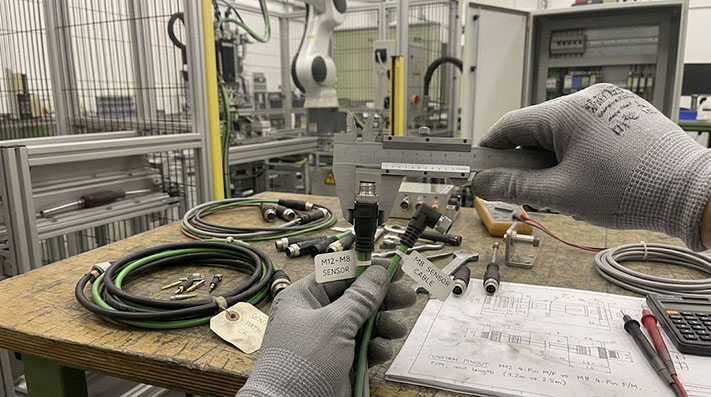
When requesting and evaluating samples, keep the following parameters in mind:
- Mechanical Clearance and Fit: Test the cable assembly in its actual physical environment. Check if the overmolded connector body interferes with adjacent ports on your sensor blocks, junction boxes, or PLC modules.
- Flexibility and Bend Radius: Verify that the cable jacket material (PVC, PUR, or TPE) handles the physical routing of your machinery. This is particularly important for high-flex drag-chain applications where tight bends can cause premature conductor wear.
- Pinout Verification: Check that the internal wiring schematic matches your system's electrical requirements. A single crossed conductor can damage sensitive machine controllers or sensors.
- Production Continuity: Ensure the supplier uses the exact same components, wire gauge, and assembly processes for the sample as they will use for the final production batch.
Factory Quality Control & 100% Electrical Verification Testing Standards
Every custom assembly—regardless of order size (from 5-piece sample batches to full runs)—undergoes strict automated cable testing before dispatch:
| QC Test Parameter | Governing Engineering Standard | Test Condition / Applied Load | Pass / Fail Acceptance Threshold | Defect Type Prevented |
|---|---|---|---|---|
| Continuity & Pinout Mapping | IPC/WHMA-A-620 Class 3 | Low-voltage DC test (5 V DC, 10 mA) | 100% Pin-to-Pin Verification (Zero open/short/crossed wires) | Miswiring, dead pins, swapped signals |
| Conductor Contact Resistance | IEC 60512-2-1 | Precision 4-wire Kelvin Sensing | ≤ 20 mΩ per conductor path | Cold solder joints, defective crimp terminals |
| Insulation Resistance (IR) | EIA-364-21 | 500 V DC applied for 60 seconds | ≥ 100 MΩ (at 500V DC) | Pin isolation failure, moisture contamination |
| Dielectric Withstanding (Hi-Pot) | IEC 60512-4-1 / UL 2238 | 1,000 V AC / 1,500 V DC for 1 second | Leakage Current < 0.5 mA (Zero Breakdown) | High-voltage arc-over, inner conductor insulation damage |
| Strain Relief Flex & Pull Test | IEC 60512-17-1 | Axial pull force (100 N for 1 minute) | No physical deformation or contact displacement | Cable jacket pull-out under heavy machine operation |
Communication Tips: Getting Accurate Quotes on the First Try
Sourcing teams and engineers often lose days to back-and-forth emails because their initial RFQ lacks necessary technical details. To get an accurate, rapid quote for a small-batch custom cable order, provide a clear specification checklist from the start.
The Small-Batch RFQ Checklist
When submitting your inquiry, include the following details:
- Connector Configurations: Specify Connector A and Connector B. Include the exact standard, shell size, coding, pin count, gender, and orientation (e.g., M12 A-code, 5-pin, female, right-angle to M8 3-pin, male, straight).
- Cable Specification: State the conductor size (AWG), shield requirements (unshielded, foil, braided, or double-shielded), and jacket material (PVC for static environments; PUR or TPE for high-flex, oil-exposed, or washdown zones).
- Dimensional Layout: Define the overall length of the assembly, including the tolerances. If you are ordering a Y-splitter or multi-branch harness, specify the length of each individual branch.
- Wiring Pinout Chart: Provide a simple pin-to-pin mapping table or drawing (e.g., Connector A Pin 1 to Connector B Pin 3). Never assume a supplier will default to a standard wiring color code, as sensor and industrial ethernet standards can vary.
- Environmental Requirements: Note if the cable will encounter high temperatures, continuous flexing, exposure to cutting oils, industrial solvents, or high-pressure washdowns.
- Quantity and Target Timeline: State your initial sample requirement along with your target production quantity (e.g., 2 samples for testing, followed by 25 production units).
Cable Outer Jacket Material Selection Matrix & Environmental Thresholds
Selecting the correct bulk cable jacket for small-batch runs avoids material minimum order quantity (MOQ) surcharges while ensuring environmental survival:
| Jacket Material | Min. Static Bend Radius | Min. Continuous Dynamic Bend Radius | Drag Chain Flexing Life (Cycles) | Resistance to CNC Coolants & Mineral Oils | Flame Retardancy / Halogen Status | Recommended Application Environment |
|---|---|---|---|---|---|---|
| PVC (Polyvinyl Chloride) | 5 × Cable OD | 10 × Cable OD | ~500,000 cycles (Static/Low-flex) | Poor to Moderate (Swells in cutting oil) | UL VW-1 / FT1 (Self-extinguishing) | General indoor cabinet wiring, static sensor runs, budget-sensitive control panels |
| PUR (Polyurethane) | 4 × Cable OD | 7.5 × Cable OD | ≥ 5,000,000 to 10,000,000 | Superior (DIN EN 60811-404 compliant) | Halogen-Free (IEC 60754-1 / LSZH) | High-speed gantry drag chains, CNC tool changers, oily machining environments |
| TPE (Thermoplastic Elastomer) | 5 × Cable OD | 8 × Cable OD | ≥ 10,000,000 cycles | Exceptional (Hydrolysis & Bio-oil proof) | UL VW-1 / High UV resistant | Extreme cold/outdoor environments (-50°C to +125°C), washdown food machinery |
| Silicone (High Thermal) | 3 × Cable OD | 6 × Cable OD | High Flex (Torsion rated) | Moderate (Solvents degrade matrix) | Halogen-Free / High Flame Resistance | High-temperature glass factories, steel mills, welding robotics (-60°C to +180°C) |
Shielding Construction, EMC Attenuation, and Transfer Impedance Limits
Custom small-batch cables used in high-EMI environments (e.g., servo drives, VFDs, high-frequency sensors) require verified shield topologies:
| Shield Topology Construction | Component Design / Construction | Optical Braid Coverage (%) | EMC Attenuation Efficiency (30MHz – 1GHz) | Transfer Impedance (Zt at 10 MHz) | Primary Industrial Application Profile |
|---|---|---|---|---|---|
| Unshielded (UTP) | PVC/PUR Outer Jacket + Twisted Pairs | 0% | 0 dB | N/A | General 24V DC discrete sensor / actuator lines |
| Aluminum Foil + Drain Wire (FTP) | Al-Mylar Tape wrapping with Tinned Copper Drain | 100% Foil Coverage | ~20 dB – 30 dB | ≤ 100 mΩ/m | Static cabinet cabling, space-constrained analog instrumentation |
| Tinned Copper Braid (STP) | High-density tinned copper wire weaving | ≥ 85% Braid Coverage | ~40 dB – 50 dB | ≤ 15 mΩ/m | Standard M12/M23 servo feedback cables, IO-Link digital buses |
| Dual Shield: Foil + Braid (SF/UTP) | Aluminum-Mylar Tape + Tinned Copper Braid | 100% Foil + ≥ 85% Braid | ≥ 65 dB (Extreme EMI Protection) | ≤ 5 mΩ/m | High-speed Industrial Ethernet (Profinet, EtherCAT), VFD motor power leads |
Streamline Your Custom Cable Sourcing with ConnecLink
At ConnecLink, we understand that industrial automation projects, prototype builds, and maintenance routines do not always require thousands of cables. High-volume MOQs should not stand in the way of getting high-quality, reliable interconnect solutions.
We specialize in supporting machine builders, system integrators, and MRO engineers with flexible production capabilities. Whether you need standard M12 sensor cables, custom M23 robotic harnesses, or specialized solenoid valve connectors, we can accommodate your specific requirements.
- Low Minimum Order Quantities: We accept custom cable orders starting as low as 10 pieces.
- Engineering Alignment: Our team works directly with your technical drawings, pinout schematics, or reference photos to ensure your custom assemblies perform exactly as intended.
- Material and Configuration Flexibility: Choose from a wide range of connector codings, pin counts, custom lengths, jacket types, and shielding options to fit your installation environment.
Remove the MOQ bottleneck from your sourcing workflow. Send us your drawings, hand sketches, or existing part specifications, and let our team provide a clear, competitive quote for your low-volume custom cable requirements.