When a servo motor cable fails, it brings a critical piece of automation to a standstill. Replacing it isn't as simple as matching the M23 connector size. The internal wiring—or pinout—of both the power and encoder cables must be a perfect match for the motor and drive. A mistake can lead to erratic performance, drive faults, or even permanent damage to your equipment.
This guide explains the critical differences between servo power and encoder cables, how to decode M23 pinouts, and what to specify to ensure you receive a reliable, compatible replacement harness. We will cover the key technical details that prevent costly errors and extended downtime.
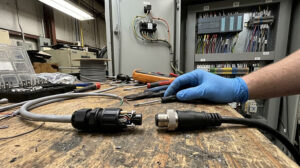
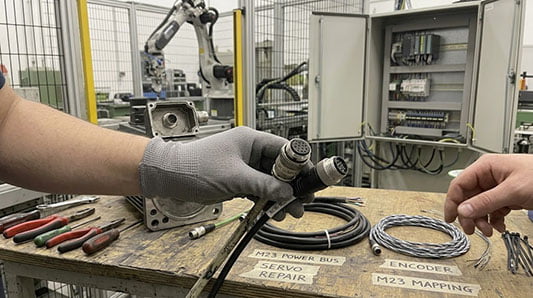
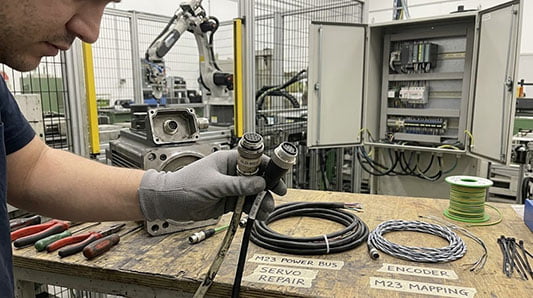
<img src="https://conneclink.com/wp-content/uploads/2026/08/A-pair-of-M23-servo-motor-cables-one-for-power-and-one-for-encoder-shown-coiled.jpg" alt="M23 servo motor power and encoder cable assemblies with circular connectors" title="Image placeholder: A pair of M23 servo motor cables, one for power and one for encoder, shown coiled." style="zoom:150%;" />
Power vs. Encoder: Why Servo Systems Use Two Separate Cables
In most servo motor applications, you will find two distinct cables connecting the motor to the drive or controller: a power cable and an encoder cable. While some systems use a single hybrid cable, the two-cable configuration is common for a critical reason: preventing electrical noise.
- Servo Power Cable: This is a thick, multi-conductor cable designed to carry high current from the servo drive to the motor windings. It often includes conductors for the three motor phases (U, V, W), a protective earth (PE) ground, and sometimes wires for an electromagnetic brake.
- Servo Encoder Cable: This is a signal-level cable that transmits precise position, speed, and direction data from the motor's encoder back to the drive. These are low-voltage signals that are highly sensitive to interference.
Separating these functions into two cables prevents the high-current switching noise from the power lines from corrupting the delicate feedback signals on the encoder lines. Attempting to run them in a single, poorly shielded cable would be like trying to whisper next to a running jet engine—the feedback signal would be lost in the noise, leading to positioning errors and drive faults.
The Critical Role of Shielding in Signal Integrity
A common cause of intermittent servo motor faults—"jittering," losing position, or throwing random errors—is a breakdown in cable shielding. This is especially true in environments with many motors, VFDs, and welders.
The shield in a servo cable acts as a Faraday cage, performing two jobs:
- Keeps Noise Out: It blocks external electromagnetic interference (EMI) from corrupting the encoder signal.
- Keeps Noise In: It contains the electrical noise generated by the power cable, preventing it from interfering with other nearby electronics.
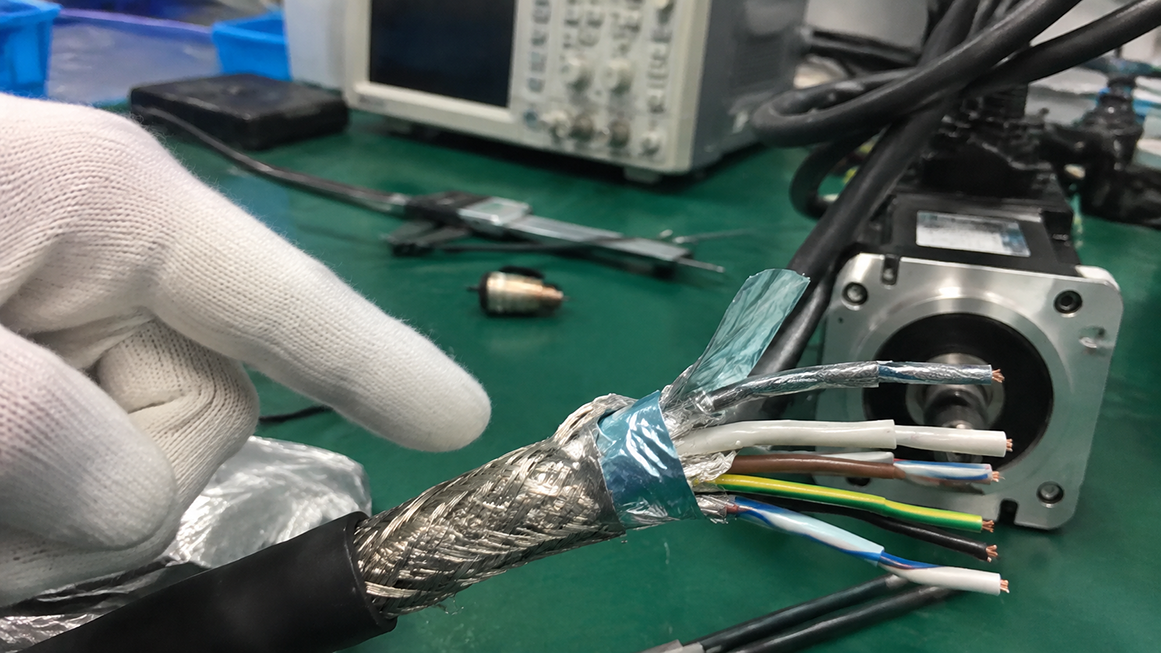
For maximum reliability, especially in dynamic applications or electrically noisy plants, a double-shielded cable is often specified. This typically consists of an aluminum foil shield for high-frequency noise protection and a tinned copper braid shield for low-frequency noise and physical durability.[^1]
Crucially, the shield must be properly terminated (grounded) at the drive end. An ungrounded or poorly connected shield can act as an antenna, making the noise problem worse.[^1] When ordering a replacement, confirm that the shield termination method matches the original equipment manufacturer's (OEM) design.
Why "M23" Doesn't Guarantee Pinout Compatibility
The term "M23" refers to the 23 mm diameter of the circular connector's locking thread.[^2] It does not define the pin count, the arrangement of those pins, or which pin does what. Different servo motor manufacturers like Siemens, Fanuc, Allen-Bradley, and others use M23 connectors but with proprietary pinouts.
Cable Flex Life for Drag Chains and Robotics
For servo motors used in motion-centric automation—like robot arms, gantries, and CNC machines—the cable is in a state of constant movement. These are known as dynamic or "high-flex" applications.
You may see cable specifications with impressive "flex life" ratings, such as "10 million bend cycles." It is important to understand what this means in practice. These ratings are typically achieved in a lab under ideal conditions: a specific bend radius, temperature, and movement speed.
In the real world, cable life is affected by:
- Bend Radius: This is the most critical factor. A cable forced into a bend tighter than its minimum specified radius will fail exponentially faster. Always respect the manufacturer's bend radius.
- Torsion: Twisting motions, common in robotics, are much more stressful on a cable's internal structure than simple back-and-forth bending in a drag chain.
- Speed and Acceleration: Higher speeds and acceleration rates increase the physical stress on the cable.
- Jacket Material: Polyurethane (PUR) jackets offer superior resistance to abrasion, oils, and chemicals and generally have better flex performance than standard PVC jackets, making them a common choice for demanding applications.
Instead of relying solely on a cycle count, provide your supplier with details about the application. Describing it as "for a 6-axis robot" or "for a 2-meter travel drag chain with a 100 mm bend radius" will result in a much more reliable cable build.
How to Specify Your M23 Servo Cable Replacement
To get a quote for a compatible and reliable replacement servo cable assembly, be prepared to provide as much information as possible. A good supplier can help you identify the right specifications even if you don't have a complete part number.
Here is a checklist of what to send with your RFQ:
- Motor & Drive Details: The motor manufacturer, model number, and drive model number. A clear photo of the motor's nameplate is often the most helpful piece of information.
- Cable Type: Specify if you need the Power Cable, Encoder Cable, or both.
- Connector Details (for both ends):
- Connector Type (e.g., M23, M40)
- Pin Count (e.g., 6-pin, 9-pin, 17-pin)
- Gender (Male or Female)
- Angle (Straight or Right-Angle)
- Cable Length: The exact length required, from connector to connector.
- Photos of Existing Connectors: If possible, send clear photos of the connector faces on your current cable. This can help instantly identify the pinout.
- Application Environment: Mention if the cable will be static, in a drag chain (C-track), or on a robot arm. Note any exposure to oils, chemicals, or welding.
- Quantity: The number of cable assemblies needed.
For a detailed look at custom assembly options, see our page on M23 Heavy-Duty Servo Motor & Encoder Cable Assemblies.
Frequently Asked Questions
1. Can I use a single hybrid cable instead of two separate M23 cables? Some modern servo systems use a single hybrid cable that contains both power and signal conductors in one jacket. While this can simplify installation, these are complex cables with multiple internal shields. For replacement, it is safest to stick with the original design—if your system used two cables, replace it with two cables.
2. What is the difference between M23 and M40 connectors for servo motors? M40 connectors are larger (40 mm thread) and are typically used for higher-power servo motors that require larger conductors to handle more current.[^2] M23 is one of the most common sizes for small to medium-sized motors.
3. Does cable length affect servo performance? Yes. For power cables, longer runs can lead to voltage drop, potentially reducing motor torque.[^4] For encoder cables, longer runs increase the risk of signal degradation and EMI, which can affect positioning accuracy.[^1] Always use the correct length needed for the application without excessive slack.
4. My servo motor has a brake. Is that part of the power cable? Yes, if the motor is equipped with an electromagnetic holding brake, the two wires that power it are typically included within the main power cable. This is a critical detail to include when specifying a replacement.
Get the Right Replacement Cable, Fast
The fastest way to get an exact match for your replacement servo cable is to send us the details of your equipment. Our team can help cross-reference the pinout and cable specifications to ensure full compatibility.
Send your request with the following information, and we will provide a detailed quote for a plug-and-play replacement:
- Photo of the servo motor nameplate
- Servo drive model number
- Photos of your existing cable connectors (if available)
- Required cable lengths for power and encoder
- Quantity needed
Contact us today to request a quote for your M23 servo motor cable assembly.
[^1]: "IEC 61000 series — Electromagnetic Compatibility (EMC)", https://www.iec.ch/emc/. Evidence role: standard_reference; source type: standards_body; origin: search_result. Supports: The IEC 61000 series establishes EMC requirements for industrial environments. Double-shielded cable construction (foil for high-frequency + braid for low-frequency and mechanical durability) is a recognized best practice for maintaining signal integrity in electromagnetically noisy environments. Accessed 2026-07-31. Scope note: General EMC standard series; specific cable shield construction practices are documented in IEC 61000-4 series testing standards and industry application guides. [^2]: "IEC 61076-2-101: Connectors for electronic equipment — Circular connectors", https://webstore.iec.ch/publication/61076-2-101. Evidence role: standard_specification; source type: standards_body; origin: search_result. Supports: IEC 61076-2-101 defines the mechanical dimensions, including the 23 mm locking thread diameter, for M23 circular connectors used in industrial applications. Accessed 2026-07-31. Scope note: Applies to M23 connector dimensional specification; pinout assignments are manufacturer-specific beyond the physical standard. [^3]: Internal link: "M23 Heavy-Duty Servo Motor & Encoder Cable Series | Custom High-Flex Robotic Harnesses — Tianlun Interconnect", https://conneclink.com/connector-product/m23-heavy-duty-servo-motor-encoder-cable-series-custom-high-flex-robotic-harnesses/. Supports: Tianlun Interconnect's M23 servo motor and encoder cable product page details custom high-flex harness options for robotic and industrial servo applications. The page covers power and encoder cable assemblies with configurable pinouts for compatibility with major servo motor brands. Scope note: Internal product page; provides RFQ pathway for customers seeking replacement M23 servo cable assemblies with verified pinout compatibility. [^4]: "IEC 60287: Electric cables — Calculation of the current rating", https://www.iec.ch/. Evidence role: standard_reference; source type: standards_body; origin: search_result. Supports: IEC 60287 establishes calculation methods for cable current ratings and voltage drop in power cables. Voltage drop in long cable runs reduces the voltage available at the motor terminals, which can proportionally reduce motor torque output. Accessed 2026-07-31. Scope note: General cable sizing standard; actual voltage drop depends on conductor cross-section, cable length, load current, and installation conditions.