
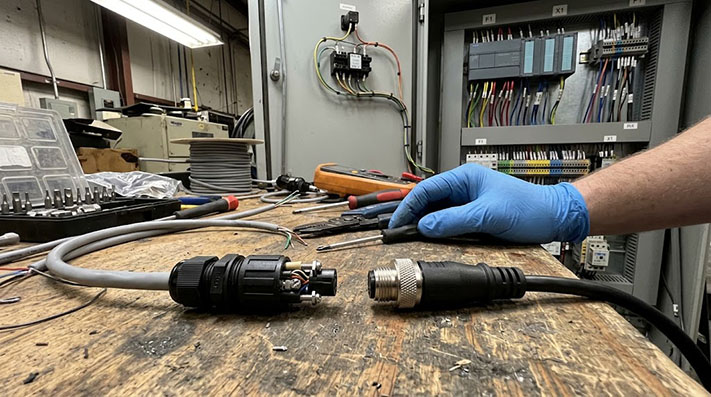
When a sensor or actuator cable fails on critical equipment, the maintenance team faces a choice: build a replacement cable on the spot using a field-wireable connector, or grab a pre-assembled, factory-molded cable from inventory[cite: 6]?
Field-wireable connectors promise ultimate flexibility—the ability to create a custom-length cable for any repair[cite: 6]. But that flexibility comes at a cost in tools, time, and quality risk[cite: 6]. For maintenance, repair, and operations (MRO) teams, understanding the total cost of each approach is key to making a smart inventory and repair strategy[cite: 6].
TL;DR: Field-Wireable vs. Pre-Assembled Cables
- Field-Wireable Connectors: Best for one-off emergency repairs, prototyping where lengths are unknown, or non-critical applications in dry, stable environments[cite: 6]. Success depends entirely on technician skill and proper tools[cite: 6].
- Pre-Assembled (Overmolded) Cables: The reliable choice for production environments, applications with vibration or moisture, and MRO teams focused on minimizing downtime[cite: 6]. They offer guaranteed performance and fast, error-proof replacement[cite: 6].
 [cite: 6]
The Real Cost of "Do-It-Yourself" Cable Assembly
Before standardizing on field-wireable connectors for repairs, calculate the true cost beyond the price of the connector itself[cite: 6]. This cost has three main parts: tools, labor, and risk[cite: 6].
1. Initial Investment: Tooling and Training
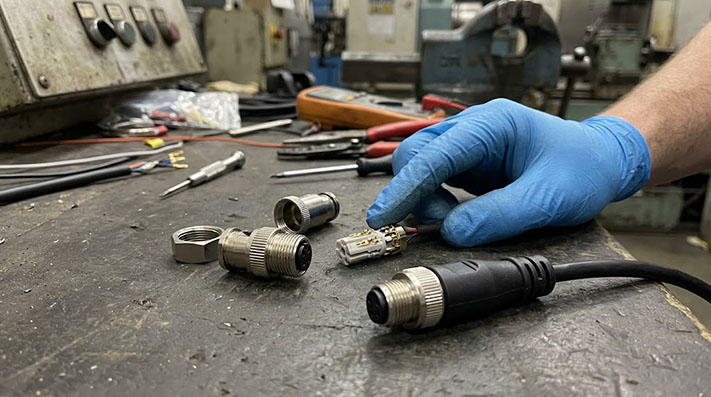
A reliable field-terminated connection requires more than a pocketknife and a screwdriver[cite: 6]. A proper toolkit for M12 field assembly includes[cite: 6]:
- Precision Wire Strippers: To remove insulation without nicking the fine copper conductors[cite: 6].
- Cable Jacket Strippers: To cleanly remove the outer cable jacket without damaging the inner wire insulation or shielding[cite: 6].
- Terminal Tools: Depending on the connector type, this could be a set of small, precision screwdrivers for screw terminals or a specific crimping tool for crimp-pin versions[cite: 6].
- Torque Wrench (Recommended): For tightening the connector's locking nut to the manufacturer's specification, ensuring a vibration-proof and properly sealed connection without damaging the connector[cite: 6].
The initial outlay for quality tools can be significant[cite: 6]. Equally important is the time spent training technicians to use them correctly and consistently for every type of connector and pinout[cite: 6].
Mechanical and Electrical Comparison of Field-Wireable Termination Technologies
Selecting the appropriate contact termination technology directly dictates assembly time, specialized tooling requirement, and long-term vibration resistance on the factory floor:
| Termination Technology | Required Stripping Precision | Contact Resistance ($R_c$) | Pull-Out Force (22 AWG / 0.34mm²) | Dynamic Vibration Resistance (IEC 60068-2-6) | Dedicated Tooling Required |
|---|---|---|---|---|---|
| Screw Termination | Jacket: 20mm, Conductor: 4.0mm ± 0.5mm | ≤ 8.0 mΩ | ≥ 40 N | Low (Requires thread-locker or periodic retightening) | Precision Screwdriver (0.2 Nm) |
| Crimp Pin Termination | Jacket: 15mm, Conductor: 3.5mm ± 0.2mm | ≤ 3.0 mΩ (Ultra-Low) | ≥ 70 N (High Retention) | High (Gas-tight crimp resists shock up to 50g) | Precision Ratchet Crimper & Locator |
| IDC / Quick-Connect (Insulation Displacement) | Jacket: 12mm, Conductor: 0mm (No Stripping) | ≤ 5.0 mΩ | ≥ 30 N | Moderate to High (Spring-loaded blades absorb micro-vibrations) | Cable Cutter only (Toolless) |
| Push-In Spring Cage | Jacket: 18mm, Conductor: 8.0mm ± 0.5mm | ≤ 4.0 mΩ | ≥ 50 N | High (Constant spring pressure prevents loosening) | Ferrule Crimper (if using fine strands) |
2. Recurring Cost: Labor Time Per Connector
Assembling a single field-wireable M12 connector can take a trained technician anywhere from 5 to 15 minutes in a clean, well-lit workshop[cite: 6].
Now, consider a real-world repair scenario[cite: 6]:
- Is the technician working in a cramped, poorly lit area of a machine[cite: 6]?
- Are they dealing with fine 24 or 26 AWG wires for an 8-pin X-Code Ethernet connector[cite: 6]?
- Are their hands cold or oily[cite: 6]?
In realistic plant-floor conditions, assembly time can easily double[cite: 6]. To calculate your labor cost, multiply this estimated time by your technician's fully-loaded hourly rate[cite: 6]. If a technician earning $40/hour takes 15 minutes per connector, that's $10 in labor for just one end of a cable[cite: 6].
3. Hidden Cost: The Risk of Assembly Errors
The biggest hidden cost is the risk of a faulty connection[cite: 6]. Unlike a factory-molded cable that is 100% electrically tested, a field-assembled connection's quality is variable[cite: 6]. A single error can lead to hours of troubleshooting and expensive downtime[cite: 6].
Common Assembly Errors and Their Consequences
A field-terminated M12 cable is only as reliable as its assembly[cite: 6]. Even skilled technicians can make mistakes that lead to intermittent failures, which are often the hardest to diagnose[cite: 6].
Precision Assembly Specifications & Torque Tolerance Matrix
Improper cable stripping length or torque application compromises both IP seal integrity and mechanical strain relief. Field technicians must adhere to these precise tolerances:
| Connector Parameter / Assembly Step | Engineering Specification | Recommended Assembly Torque | Operational Failure Mode If Out of Spec |
|---|---|---|---|
| M12 Coupling Nut Tightening Torque | Metal Nut: 0.6 Nm, Plastic Nut: 0.4 Nm | 0.6 Nm (Calibrated Torque Wrench) | Under-torque: Loose under vibration; Over-torque: Cracked O-ring / threads |
| Cable Gland Strain Relief Dome | Cable Outer Diameter (OD): 4.0 mm – 8.0 mm | 1.5 Nm – 2.0 Nm | Moisture capillary ingress past sealing grommet |
| Terminal Screw Clamping Torque | Wire Gauge: 24 AWG to 18 AWG | 0.2 Nm ± 0.05 Nm | Wire strand shearing (over-tightened) or thermal resistance spike (loose) |
| Conductor Insulation Strip Length | 4.0 mm (+0.5mm / -0mm) | N/A | Excess exposed copper causes pin-to-pin shorts inside housing |
| Cable Jacket Outer Strip Length | 15.0 mm to 20.0 mm | N/A | Shielding braid fold-back fails to establish 360° EMC contact |
| Assembly Error | Immediate Cause | Long-Term Consequence |
|---|---|---|
| Incorrect Wire Stripping | Conductor is nicked or cut; too much or too little insulation is removed[cite: 6]. | Weakened wire breaks from vibration; risk of short circuits if insulation is too short[cite: 6]. |
| Loose Terminal Connection | Screw terminal is not tightened enough, or crimp is not fully compressed[cite: 6]. | Intermittent signal or power loss; connection heats up under load, causing failure[cite: 6]. |
| Incorrect Pinout | Wires are inserted into the wrong positions in the connector insert[cite: 6]. | Device does not function; potential for short circuits that damage the sensor or I/O card[cite: 6]. |
| Improper Sealing | O-rings or cable glands are missing, damaged, or not seated correctly[cite: 6]. | Loss of IP rating; moisture and dust enter the connector, causing corrosion and failure[cite: 6]. |
| Incorrect Torque | The coupling nut is under-tightened or over-tightened[cite: 6]. | Connection vibrates loose over time; or the connector housing cracks, compromising the seal[cite: 6]. |
The Alternative: Factory Overmolded Cable Assemblies
Pre-assembled, overmolded M12 cables solve the problems of variability and hidden costs[cite: 6]. The connector is terminated to the cable in a controlled factory environment, and the entire assembly is sealed in a single, robust unit[cite: 6].
Key Advantages:
- Guaranteed IP Rating: Factory overmolding provides a reliable, tested seal (e.g., IP67) that is essential for washdown, high humidity, or dusty environments[cite: 6].
- Superior Strain Relief: The overmold protects the internal wire terminations from stress caused by vibration, pulling, and bending, drastically improving the cable's lifespan[cite: 6].
- 100% Tested: Reputable suppliers electrically test every cable assembly before it ships, eliminating the risk of out-of-the-box failures from incorrect wiring[cite: 6].
- Fast Replacement: The fastest way to fix a failed cable is to unplug it and plug in a known-good replacement[cite: 6]. This minimizes Mean Time To Repair (MTTR) and gets your equipment back online faster[cite: 6].
Engineering Benchmark: Field-Wireable vs. Factory Overmolded Assemblies
A quantitative performance evaluation comparing technician-assembled field units against high-volume injection-molded factory assemblies:
| Engineering Performance Metric | Field-Wireable M12 Assembly | Factory Overmolded M12 Assembly | Testing Standard & Method |
|---|---|---|---|
| Ingress Protection Rating | IP65 / IP67 (Tooling Dependent) | IP67 / IP68 (1m for 24h) / IP69K (High-Pressure Washdown) | IEC 60529 / DIN 40050-9 |
| Insulation Resistance ($R_{text{iso}}$) | ≥ 100 MΩ (At 500V DC) | ≥ 1,000 MΩ (1 GΩ at 500V DC) | IEC 60512-3-1 |
| Dielectric Withstand Voltage | 1,400V AC / 1 minute | 2,000V AC / 1 minute | IEC 60512-2-1 |
| Mechanical Flexing Life (Drag Chain) | ~500,000 Cycles (Strain relief limit) | ≥ 5,000,000 to 10,000,000 Cycles | EN 50396 Dynamic Test |
| Quality Control Testing Standard | Spot-check / Visual inspection | 100% Automated Testing (Pinout, Continuity, Short, Hi-Pot) | ISO 9001 Factory Quality Assurance |
| Mean Time Between Failures (MTBF) | ~15,000 Operating Hours | > 100,000 Operating Hours | MIL-HDBK-217F Industrial Profile |
Total Cost of Ownership (TCO) Calculator for MRO Cable Replacement
To quantify the financial impact of cable sourcing strategies, this benchmark compares a single emergency repair scenario assuming an average downtime cost of $500/hour:
| Cost Factor / Operational Metric | Field-Wireable Assembly Option | Factory Overmolded Cable Option | Cost Impact & Engineering Rationale |
|---|---|---|---|
| Component Acquisition Cost | ~$8.00 (Connector) + Bulk Cable | ~$12.00 (Complete Pre-Tested Assembly) | Overmolded unit incurs slightly higher initial part cost |
| Dedicated Tooling Amortization | ~$1.50 per assembly | $0.00 | Strippers, crimpers, torque drivers required for field assembly |
| Direct Technician Labor Time | 15 – 25 Minutes per end | 1 – 2 Minutes (Plug & Play) | 90% reduction in technician labor time per cable swap |
| Direct Labor Cost ($50/hr Rate) | ~$16.50 | ~$1.25 | Labor cost for field assembly exceeds total price of molded cable |
| Risk-Weighted Downtime Exposure | High (5% rework rate due to errors) | Zero (100% pre-tested out of box) | A single wiring error delays machine restart by 30+ minutes |
| Estimated Total Installed Cost | ~$26.00 + Downtime Risk | ~$13.25 Total | Factory overmolded assemblies reduce total repair cost by ~50% |
Decision Guide: When to DIY, When to Buy Pre-Assembled
Use this checklist to decide which strategy makes sense for your team[cite: 6].
Choose Field-Wireable M12 Connectors if:
- You are performing a one-time, emergency repair and do not have a spare assembly[cite: 6].
- You are prototyping new equipment and cable lengths are unpredictable[cite: 6].
- The application is in a clean, dry, low-vibration area[cite: 6].
- You have a dedicated workspace, a complete set of quality tools, and technicians trained in connector assembly[cite: 6].
Choose Pre-Assembled M12 Cables if:
- The application requires a high IP rating for moisture or dust protection[cite: 6].
- The cable will be exposed to machine vibration, shock, or frequent movement[cite: 6].
- Minimizing equipment downtime is a top priority[cite: 6].
- You want to standardize your MRO inventory and ensure consistent, reliable repairs regardless of which technician is on duty[cite: 6].
Make an Informed Sourcing Decision
For many MRO teams, the calculation is clear[cite: 6]. The upfront cost of a pre-assembled cable is often less than the total cost of assembling one in the field, especially when you factor in labor and the risk of failure[cite: 6]. Stocking a small inventory of common M12 cable types and lengths provides the best balance of readiness and reliability[cite: 6].
If you're ready to compare the total cost of ownership, ConnecLink can help[cite: 6]. We provide a wide range of factory-tested, overmolded M12 and M8 cable assemblies for industrial automation[cite: 6]. Send us your requirements—including connector type, pinout, and annual volume—for a competitive quote on a reliable, ready-to-install solution[cite: 6].