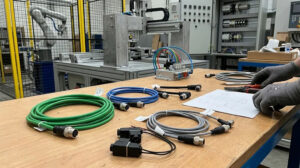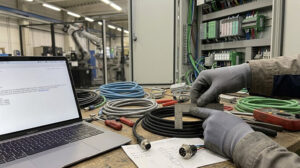
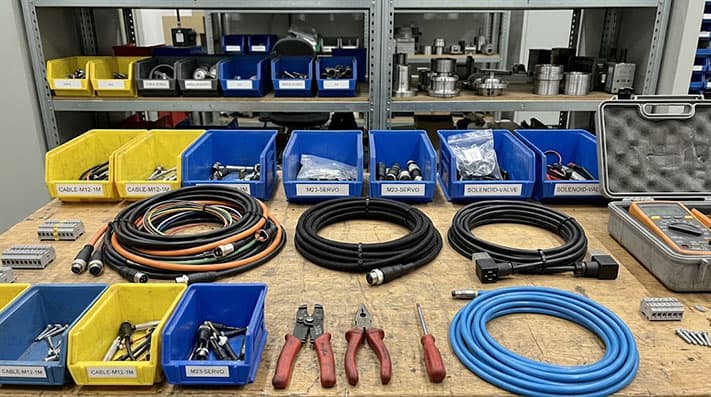
For a Maintenance, Repair, and Operations (MRO) team, unscheduled downtime is the enemy[cite: 11]. A production line can halt not because of a complex PLC failure, but because a single sensor cable was crushed by a cart or a solenoid valve connector finally succumbed to vibration[cite: 11]. Having the right replacement cable on hand is the difference between a five-minute fix and a five-hour scramble to identify and source a basic part[cite: 11].
A strategic replacement cable inventory focuses on reducing downtime without accumulating a warehouse of expensive, rarely used spares[cite: 11]. The key is to move from a reactive "order on failure" model to a proactive system based on equipment analysis, part consolidation, and smart storage[cite: 11]. This guide provides a framework for building that system[cite: 11].
Identifying Critical Spares: Which Cables Break First?
Not all cables have the same risk of failure[cite: 11]. Instead of stocking one of everything, start by analyzing your facility's failure patterns[cite: 11]. A walk-through of your production areas will reveal the most common points of stress for industrial cables[cite: 11].
Industrial Cable Failure Modes, Field Failure Rates & MTBF Benchmark
Quantifying historical failure profiles across harsh factory environments enables MRO teams to prioritize high-risk cables in the spare parts inventory:
| Factory Environment / Stress Zone | Primary Cable Failure Mechanism | Estimated Annual Failure Rate | Mean Time Between Failures (MTBF) | Recommended Stocking Priority |
|---|---|---|---|---|
| Robotic Arms / Articulated Axes | Conductor metal fatigue & core snapping | 15% to 25% per annum | ~8,000 to 12,000 Operating Hours | Critical (High Priority) |
| High-Frequency Drag Chains (CNC) | Insulation abrasion & shield puncturing | 10% to 18% per annum | ~15,000 Operating Hours | Critical (High Priority) |
| Hydraulic / Washdown Manifolds | Liquid ingress (IP67 breach) & O-ring decay | 8% to 12% per annum | ~20,000 Operating Hours | Moderate Priority |
| Fixed Control Cabinets / Trays | Thermal degradation & rodent damage | Less than 2% per annum | > 50,000 Operating Hours | Low Priority (Run-to-Failure) |
Focus your initial inventory on cables exposed to these conditions[cite: 11]:
- Mechanical Movement and Vibration: Cables connected to robotic arms, moving gantries, and high-vibration equipment are prime candidates for failure[cite: 11]. The constant flexing and stress on the connector and cable strain relief lead to intermittent faults and eventual breakage[cite: 11]. Pay close attention to M23 servo motor cables and M8/M12 sensor cables on automated equipment[cite: 11].
- Physical Impact and Abrasion: Look for cables routed along walkways, near forklift traffic, or dragged across rough surfaces[cite: 11]. The outer jacket is the first line of defense, and once it's compromised, the cable's internal conductors are vulnerable[cite: 11].
- Fluid Exposure: In areas with hydraulics, coolants, or washdown processes, fluid ingress is a major cause of connector failure[cite: 11]. Solenoid valve connectors on hydraulic manifolds and M12 sensor cables near cutting tools are particularly susceptible[cite: 11]. An indicator LED failing on a solenoid valve connector is often the first sign of an internal short caused by moisture[cite: 11].
- Connector Damage: Connectors can be crushed, over-tightened, or have their locking threads stripped[cite: 11]. Straight connectors in tight spaces are often bent, stressing the termination point[cite: 11]. Right-angle connectors can solve this but may be more exposed to side impacts[cite: 11].
Your maintenance logs are your best source of data[cite: 11]. If the logs are incomplete, a simple tally sheet kept by technicians for a month can quickly identify which one or two cable types cause 80% of your line-down events[cite: 11].
OEM-Specific vs. Standardized Cables: A Consolidation Strategy
A common barrier to an efficient inventory is the belief that you must stock the exact OEM-branded part number for every machine[cite: 11]. An equipment builder may use a dozen different cable suppliers, leaving your storeroom with many functionally identical cables under different part numbers[cite: 11].
The solution is to deconstruct the cable to its core specifications[cite: 11]. An M12 sensor cable, for example, is defined by a few key attributes, not the machine builder's part number[cite: 11].
To consolidate your SKUs, create a cross-reference list[cite: 11]:
| OEM Part Number | Machine/Application | Core Specifications | Consolidated Stocking Part |
|---|---|---|---|
| WB-45-XYZ-01 | Conveyor Sensor | M12, A-Code, 4-Pin, Female, Straight, 5m, PVC | M12-A4-FS-5M-PVC |
| 7899-23A-CBL | Part-In-Place Jig | M12, A-Code, 4-Pin, Female, Straight, 5m, PVC | M12-A4-FS-5M-PVC |
| SENS-CBL-5M | Vision System Trigger | M12, A-Code, 4-Pin, Female, Straight, 5m, PVC | M12-A4-FS-5M-PVC |
MRO Inventory Consolidation & Economic Order Quantity (EOQ) Analysis
Transitioning from fragmented OEM-branded part numbers to consolidated, multi-purpose standardized industrial cable assemblies transforms inventory efficiency:
| Inventory Strategy Parameter | Fragmented OEM-Specific Model | Consolidated Standardized Model | Financial & Operational Impact |
|---|---|---|---|
| Total Active Cable SKUs in Stock | 120 to 180 Unique Part Numbers | 15 to 25 Standardized SKUs | Up to 80% reduction in warehouse SKU clutter |
| Average Component Acquisition Cost | High (OEM markup: $35 – $80 / pc) | Moderate ($12 – $25 / pc) | Eliminates brand-name distributor price inflation |
| Supplier Lead Time (Restocking) | 4 to 8 Weeks (Factory direct import) | In-Stock / 2 to 3 Days | Immediate local availability minimizes line downtime |
| Minimum Order Quantity (MOQ) | 50 to 100 pcs per OEM part | 5 to 10 pcs (Standard bulk) | Prevents capital lockup in slow-moving inventory |
| Annual Inventory Holding Cost | Estimated at $15,000+ | Estimated under $3,000 | Frees up working capital for critical maintenance |
By breaking down the OEM part into its fundamental connector family, coding, pin count, gender, orientation, length, and jacket material, you can often replace dozens of unique part numbers with a handful of standardized, multi-purpose cables[cite: 11]. This dramatically reduces inventory costs and makes it easier for technicians to find the right part[cite: 11].
Key specifications to document for consolidation include[cite: 11]:
- Connector A: e.g., M12 Male 8-Pin X-Code[cite: 11]
- Connector B: e.g., RJ45 or Unterminated (flying leads)[cite: 11]
- Length: e.g., 2 meters, 5 meters[cite: 11]
- Jacket Material: PVC (general purpose) or PUR (flex, oil resistance)[cite: 11]
- Special Features: Shielding for Ethernet (D-Code, X-Code), LED indicators for sensors or solenoid valves[cite: 11].
Storage and Labeling for Fast Retrieval
A well-stocked inventory is useless if the parts can't be found quickly[cite: 11]. A chaotic parts cage is a major source of extended downtime[cite: 11]. Implement a clear and simple storage system[cite: 11].
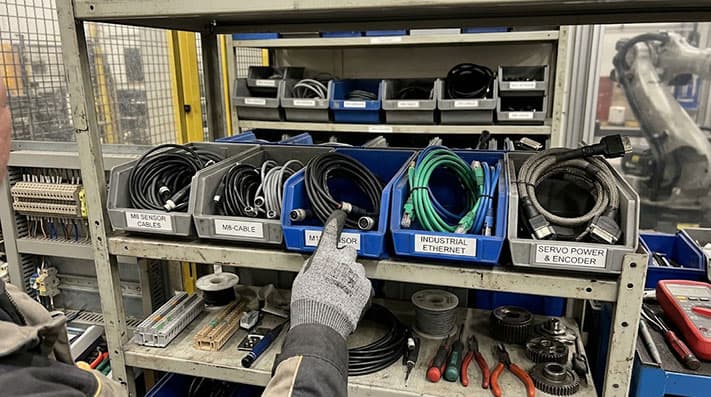 [cite: 11]
MRO Spare Parts ABC Inventory Classification & Safety Stock Matrix
Establishing dynamic min/max stock levels based on equipment criticality and financial exposure ensures zero stock-outs on mission-critical lines:
| Inventory Classification | Criticality & Annual Usage Value | Line-Down Cost Impact | Recommended Min/Max Control Policy | Reorder Trigger & Replenishment Logic |
|---|---|---|---|---|
| Category A (Mission Critical) | High value / Low volume (e.g., Robot servo cables) | Extremely High ($1,000+ / minute) | Min: 2 pcs / Max: 5 pcs | Two-Bin System: Immediate re-order when 1st piece is consumed |
| Category B (Essential Standard) | Moderate value / Medium volume (e.g., M12 Ethernet trunks) | Moderate ($100 – $500 / minute) | Min: 5 pcs / Max: 15 pcs | Periodic Review (Bi-weekly batch replenishment) |
| Category C (General MRO Spares) | Low value / High volume (e.g., Standard sensor pigtails) | Low ($10 – $50 / minute) | Min: 10 pcs / Max: 30 pcs | Min/Max Threshold: Reorder when stock hits minimum line |
Best Practices for Cable Storage[cite: 11]:
- Label the Bin and the Part: Every storage bin should be clearly labeled with the consolidated part name (e.g.,
M12-A4-FS-5M-PVC)[cite: 11]. For bonus points, put a picture of the cable on the bin[cite: 11]. Also, apply a tag with the same identifier directly to the cable itself[cite: 11]. - Use a "First In, First Out" (FIFO) System: Ensure older stock is used before new stock to prevent cable materials from aging on the shelf[cite: 11].
- Store Correctly: Avoid coiling cables too tightly, which can damage the internal conductors over time[cite: 11]. Hang cables on racks or use large-diameter loops if storing them in bins[cite: 11]. Protect connectors from being crushed or contaminated[cite: 11].
- Set Min/Max Levels: Determine the minimum quantity you need to have on hand to cover lead times and the maximum you want to stock to avoid tying up capital[cite: 11]. A simple two-bin system (pulling from the front bin, with the back bin holding the re-order quantity) can be very effective[cite: 11].
Build Your Strategic Cable Inventory with ConnecLink
Analyzing failure modes, consolidating part numbers, and organizing your storeroom are the foundational steps to reducing cable-related downtime[cite: 11]. The final step is working with a supplier who understands the needs of MRO and can act as a partner in this process[cite: 11].
ConnecLink specializes in the standard industrial connectors and cable assemblies that form the backbone of factory automation[cite: 11]. We focus on M8 and M12 sensor/actuator cables, industrial Ethernet, M23 servo harnesses, and solenoid valve connectors[cite: 11].
Instead of trying to cross-reference hundreds of OEM part numbers yourself, let us help[cite: 11]. Send us your list of critical equipment—including PLC brands, robot models, sensor and valve types—or a list of the OEM cable part numbers you currently buy[cite: 11]. Our team can help you deconstruct those requirements into a consolidated list of standard, high-use cables[cite: 11]. We can propose a strategic spare parts kit designed specifically for your facility, helping you reduce your SKU count and build a more effective, cost-efficient inventory[cite: 11].
<!--[googlesitekit-end-of-content]-->