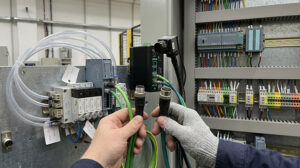

When specifying high-speed Ethernet for industrial machinery, a common question arises: can we just use a standard Cat6 cable like the one in our office[cite: 6]? While both M12 X-Code and standard Cat6 cables with RJ45 connectors can transmit Gigabit Ethernet data, they are designed for fundamentally different environments[cite: 6]. Choosing the wrong one can lead to intermittent data loss, connection failures, and costly machine downtime[cite: 6].
The decision comes down to where the cable will be installed[cite: 6]. For connections entirely inside a protected, sealed control cabinet, a standard Cat6 cable may be sufficient[cite: 6]. For any connection exposed to the factory floor—on a robotic arm, near a motor, or in an area with washdowns—an M12 X-Code industrial connector is the more reliable choice[cite: 6].
 [cite: 6]
Key Differences: Environment, Reliability, and Signal Integrity
The choice between an industrial M12 and a commercial RJ45 isn't about data speed alone[cite: 6]. It's about ensuring that speed is maintained reliably under industrial stress[cite: 6]. The physical design of the connector is the most significant factor[cite: 6].
Physical Robustness and Sealing
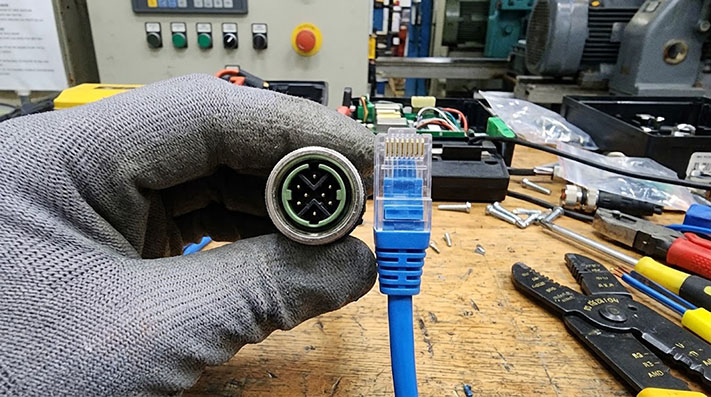
A standard Cat6 cable is typically terminated with an RJ45 connector[cite: 6]. This connector uses a small plastic retention latch to stay in place[cite: 6]. It offers no protection against moisture or fine dust and is highly susceptible to vibration, which can cause the latch to fatigue, break, or simply loosen over time[cite: 6].
An M12 connector, by contrast, features a rugged, circular design with a threaded coupling[cite: 6].
- Vibration Resistance: The screw-on metal housing locks the connection securely, preventing it from loosening due to machine vibration[cite: 6].
- Ingress Protection (IP): When properly mated, M12 connectors are designed to provide a sealed interface, protecting the contacts from dust, fluids, and cleaning agents[cite: 6]. This is a critical feature for any on-machine or exposed installation[cite: 6].
Electrical Performance in Noisy Environments
Industrial settings are full of electromagnetic interference (EMI) from motors, variable frequency drives (VFDs), and welding equipment[cite: 6]. This electrical noise can corrupt data signals, causing packet loss and communication errors[cite: 6].
The M12 X-Code connector was specifically designed to protect high-speed Ethernet signals in these conditions[cite: 6]. The "X-Code" refers to the internal pin arrangement, which isolates the four data pairs with a cross-shaped shield[cite: 6]. This design minimizes crosstalk between pairs and provides superior protection against external EMI compared to the unshielded design of a typical RJ45 connector[cite: 6]. While shielded Cat6 cable exists, the RJ45 connector itself remains the weak point in the signal path[cite: 6].
High-Frequency Signal Integrity & Electrical Performance Matrix
To maintain error-free 10 Gbps Industrial Ethernet communication near heavy electromagnetic interference (EMI) sources, physical layer transmission parameters are critical:
| Signal Integrity & Electrical Metric | M12 X-Code Industrial Assembly | Standard Cat6 RJ45 Commercial Patch Cord | Engineering Standard & Testing Method |
|---|---|---|---|
| Max Transmission Bandwidth | Up to 500 MHz (Cat6A Performance) | 250 MHz (Standard Cat6) | ISO/IEC 11801 Class EA Channel |
| Near-End Crosstalk (NEXT) at 100MHz | Greater than or equal to 44.3 dB (Superior isolation) | ~39.3 dB | TIA-568-C.2 Component Specification |
| Return Loss (RL) up to 500 MHz | Greater than or equal to 17.3 dB | Degradable outside controlled cabinets | IEC 60603-7-41 / -51 |
| Shielding Transfer Impedance ($Z_t$) | Less than or equal to 10 m-ohms / m (at 10MHz) | Greater than 50 m-ohms / m (Unshielded standard) | IEC 62153-4-3 Transfer Attenuation |
Comparison at a Glance: M12 X-Code vs. Standard Cat6/RJ45
| Feature | M12 X-Code Industrial Cable | Standard Cat6 Cable with RJ45 Connector |
|---|---|---|
| Connector Type | Circular, threaded metal coupling | Rectangular, plastic housing with retention latch[cite: 6] |
| Locking Mechanism | Screw-on, high vibration resistance[cite: 6] | Plastic tab, low vibration resistance[cite: 6] |
| Environmental Sealing | Designed for high ingress protection (e.g., IP67)[cite: 6] | None (IP20), open to dust and moisture[cite: 6] |
| EMI/Crosstalk Shielding | Excellent; X-coding isolates data pairs[cite: 6] | Dependent on cable; connector offers no shielding[cite: 6] |
| Typical Environment | On-machine, robotics, washdown areas, factory floor[cite: 6] | Inside sealed control panels, data closets, offices[cite: 6] |
| Data Rate Capability | Supports 1 Gbps and up to 10 Gbps Ethernet[cite: 6] | Supports 1 Gbps; 10 Gbps over shorter distances[cite: 6] |
Mechanical Robustness, Vibration Endurance & Ingress Protection Standards
Industrial automation environments subject network drops to relentless mechanical stress and chemical washdowns:
| Mechanical & Environmental Parameter | M12 X-Code Industrial Cable Assembly | Standard Cat6 Commercial RJ45 Cord | Industrial Engineering Rationale |
|---|---|---|---|
| Mating / Insertion Durability | Greater than or equal to 500 Cycles | ~250 Cycles (Plastic latch fatigue) | IEC 60512-9-1 Gold contact retention |
| Vibration & Shock Resistance | 10–2000 Hz, 20g Acceleration | Unsuitable (Latch opens or de-seats) | IEC 60068-2-6 / IEC 60068-2-27 |
| Ingress Protection (IP Rating) | IP67 / IP68 / IP69K (Fully Sealed) | IP20 (Open latch / No sealing) | DIN 40050-9 / IEC 60529 |
| Coupling Locking Mechanism | Threaded M12 x 1.0 Metal Nut (0.6 Nm Torque) | Plastic Retention Tab | Withstands high pulling tension and drag |
When is a Standard Cat6 Cable Acceptable in an Industrial Setting?
Despite its limitations, a standard Cat6 cable with RJ45 connectors has a place in industrial automation[cite: 6]. It is a cost-effective and practical choice for connections that are made within a clean, dry, and vibration-free environment[cite: 6].
Common acceptable uses include[cite: 6]:
- Patching between switches inside a large, sealed main control cabinet[cite: 6].
- Connecting an industrial PC or HMI that is permanently mounted inside an enclosure[cite: 6].
- Wiring within a server room or data closet that supports the factory network[cite: 6].
The risk appears the moment an RJ45 connection is exposed to the production environment[cite: 6]. A single instance of a cleaning crew spraying down a machine can ruin an unsealed RJ45 port, and a loose connection from vibration can be difficult to troubleshoot[cite: 6].
Application-Specific Cable Jacket & Shielding Selection Matrix
Selecting the proper internal construction prevents catastrophic network failure when deploying Ethernet drops across harsh industrial topologies:
| Factory Application Environment | Recommended Jacket Material | Shielding Topology Requirement | Min. Dynamic Bend Radius | Primary Failure Risk Mode if Mismatched |
|---|---|---|---|---|
| High-Flex Robotic Arm (Axis 1–6) | PUR (Polyurethane) | S/FTP (Individual Pair Foil + Heavy Braid) | 10 x Outer Diameter (OD) | Conductor core snap or shield rupture from torsion |
| Food & Beverage High-Pressure Washdown | TPE / Special PUR | Tinned Copper Braid (Corrosion Resistant) | 7.5 x OD | Chemical degradation and moisture ingress |
| Standard Cable Tray / Machine Frame | PVC or PUR | SF/UTP (Overall Foil + Braid) | 5 x OD | Jacket abrasion against sharp metal edges |
| Sealed Control Cabinet (Internal HMI) | PVC (Standard) | Unshielded or Foil-Only (UTP / F/UTP) | 4 x OD | Minimal risk; purely cost-optimized |
Specifying the Right Cable Assembly for Your Machine
Choosing an M12 X-Code cable assembly is the first step[cite: 6]. The next is defining the exact configuration for your application[cite: 6]. When preparing an RFQ for an industrial Ethernet cable, providing clear details ensures you get a component that fits perfectly and performs reliably[cite: 6].
Consider the following[cite: 6]:
- Connector A & B: Do you need M12-to-M12, or M12-to-RJ45 for connecting to a device inside a panel[cite: 6]? Specify male or female and if a right-angle orientation is needed to save space[cite: 6].
- Cable Length: Measure the required length for the specific cable run[cite: 6].
- Application: Describe where the cable will be used[cite: 6]. Is it a static connection, or will it be subject to repeated flexing on a robotic arm or moving gantry[cite: 6]?
- Data Requirements: Confirm if your network operates at 100 Mbps, 1 Gbps, or 10 Gbps[cite: 6].
If you are designing a new system or replacing a failing commercial cable, confirming the connection interface and environmental conditions is essential[cite: 6]. For robust, long-term performance on the factory floor, the M12 X-Code standard provides a clear advantage in reliability[cite: 6].
At ConnecLink, we focus on industrial connectors and cable assemblies for automation builders and MRO teams[cite: 6]. If you are unsure which connector or cable configuration your equipment requires, send us your requirements, a drawing, or a photo of the target interface[cite: 6]. Our team can help you identify the right solution for your application[cite: 6].
<!--[googlesitekit-end-of-content]-->