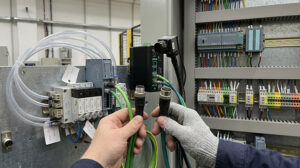
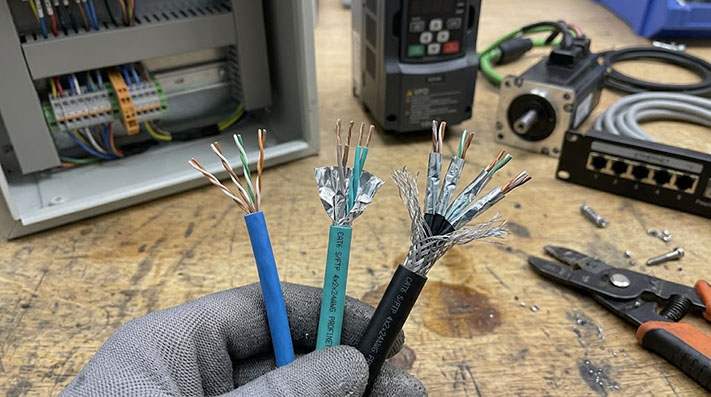
When selecting an industrial Ethernet cable, such as an M12 D-Code or X-Code assembly, the choice of shielding can seem like a minor detail[cite: 13]. However, in a factory environment filled with electrical noise, this decision is critical[cite: 13]. Choosing an unshielded cable to save a few dollars can lead to intermittent data loss, phantom machine faults, and costly production downtime[cite: 13]. Understanding the differences between unshielded (U/UTP), foiled (F/UTP or U/FTP), and screened (S/FTP) cables helps you invest in reliability where it matters most[cite: 13].
The right level of shielding depends entirely on the electromagnetic interference (EMI) in your cable's installation path[cite: 13]. For a quiet control cabinet, unshielded might suffice[cite: 13]. For a cable run near a variable frequency drive (VFD), robust shielding is not optional—it is a requirement for stable operation[cite: 13].
What Generates EMI on the Factory Floor?
Electromagnetic interference is unwanted electrical noise generated by other equipment[cite: 13]. This energy can couple onto your Ethernet cable and corrupt the data signals traveling within it[cite: 13]. The result is packet loss, reduced bandwidth, and unstable connections that can take a machine offline[cite: 13].
Common sources of powerful EMI in industrial settings include[cite: 13]:
- Variable Frequency Drives (VFDs) and Servo Drives: These motor controls are a primary source of high-frequency electrical noise[cite: 13].
- Servo Motor Power Cables: Cables carrying power to motors radiate a strong magnetic field[cite: 13]. Running a data cable parallel to a power cable is a common cause of interference[cite: 13].
- Welding Equipment: Both resistance and arc welders generate intense bursts of EMI[cite: 13].
- Contactors and Relays: The switching of high-current inductive loads can create significant electrical noise[cite: 13].
- Switch-Mode Power Supplies (SMPS): These are efficient but can be another source of high-frequency noise[cite: 13].
If your Ethernet cable will be installed within a few feet of any of these sources, especially if it runs parallel to power lines, you need to prioritize shielding[cite: 13].
Factory EMI Noise Sources, Coupling Mechanisms & Recommended Shielding Topology
Mapping specific industrial noise generators to the required physical layer shielding topology prevents phantom communication faults:
| Industrial EMI Source | Primary Noise Coupling Mechanism | Frequency Spectrum Affected | Minimum Required Shielding Topology | Risk of Using Unshielded (U/UTP) Cable |
|---|---|---|---|---|
| Variable Frequency Drives (VFDs) | Common-mode high-frequency PWM pulses | 150 kHz – 30 MHz | S/FTP or F/UTP with 360° M12 shell bond | Critical data corruption, frame drops, and lost PLC connection. |
| Servo Motor Power Cables | High transient magnetic fields (Parallel runs) | 1 MHz – 100 MHz | U/FTP or S/FTP (Individual Pair Foils) | High cross-pair crosstalk and packet re-transmissions. |
| Resistance & Arc Welders | High-energy electromagnetic bursts (Transient) | Wideband (0.1 MHz – 1 GHz) | S/FTP (Braided Screen + Pair Foils) | Complete link reset or physical transceiver damage. |
| Inductive Relays / Contactors | Spark discharge and inductive kickback | High-frequency ringing | F/UTP or higher | Intermittent CRC errors in industrial protocols. |
 [cite: 13]
Decoding Cable Shielding Acronyms: UTP, FTP, and STP
The terminology for cable shielding can be confusing[cite: 13]. The industry standard format (ISO/IEC 11801) uses an XX/YTP structure to describe the construction precisely[cite: 13].
- XX/ refers to the overall shield around all the twisted pairs[cite: 13].
- /YTP refers to the shield on the individual twisted pairs[cite: 13].
The letters have specific meanings[cite: 13]:
- U = Unshielded[cite: 13]
- F = Foil Shield[cite: 13]
- S = Braided Screen (Shield)[cite: 13]
- TP = Twisted Pair[cite: 13]
Here are the most common configurations you will encounter[cite: 13]:
| Acronym | Overall Shield (XX/) | Individual Pair Shield (/YTP) | Common Application |
|---|---|---|---|
| U/UTP | Unshielded | Unshielded | Office networks or electrically quiet industrial zones. Not recommended for most factory-floor applications[cite: 13]. |
| F/UTP | Foil | Unshielded | Good general-purpose shielding against external EMI. Often called "STP" in marketing terms[cite: 13]. |
| U/FTP | Unshielded | Foil | Excellent protection against crosstalk between pairs. A strong choice for high-speed Gigabit Ethernet (e.g., M12 X-Code)[cite: 13]. |
| S/FTP | Braided Screen | Foil | Maximum protection. The foil on each pair prevents crosstalk, and the overall braid provides robust immunity to external EMI[cite: 13]. |
Quantitative Shielding Performance: Transfer Impedance & Shielding Attenuation
Evaluating shielding effectiveness through standardized metrics ensures the selected cable can withstand high-frequency noise generated by industrial inverters:
| Shielding Acronym & Construction | Optical Braid Coverage (%) | Transfer Impedance ($Z_t$ at 10 MHz) | Shielding Attenuation (30 MHz – 1 GHz) | Electromagnetic Environment Suitability |
|---|---|---|---|---|
| U/UTP (Unshielded) | 0% (No shielding) | Greater than 100 m-ohms / m | < 30 dB | Electrically quiet office or clean control cabinets only. |
| F/UTP (Overall Foil) | 100% Foil Coverage | ~20 m-ohms / m to 50 m-ohms / m | ~40 dB to 50 dB | Standard industrial machine cells with moderate electrical noise. |
| U/FTP (Individual Pair Foil) | 100% Pair Foils | Less than or equal to 10 m-ohms / m | ~60 dB | High-speed Gigabit / 10G links (M12 X-Code) requiring pair-to-pair isolation. |
| S/FTP (Overall Braid + Pair Foil) | Greater than or equal to 85% Braid | Less than or equal to 3 m-ohms / m (Ultra-Low) | Greater than or equal to 80 dB (Maximum) | Severe EMI environments (Near VFDs, servo drives, and welders). |
A Practical Selection Framework for Your Application
Instead of over-specifying or under-specifying, match the shielding to the environment[cite: 13].
Scenario 1: Low-Noise Environment
- Description: Inside a clean control cabinet, far from motors and power lines[cite: 13]. No parallel runs with high-voltage cables[cite: 13].
- Recommendation: U/UTP can be functional here, especially for 100 Mbps Ethernet (M12 D-Code)[cite: 13].
- Consideration: The cost savings are often minimal[cite: 13]. A basic shielded cable like F/UTP provides a safety margin against future equipment changes or unforeseen noise, making it a safer default choice even in "clean" areas[cite: 13].
Scenario 2: General Automation Environment
- Description: On-machine wiring for conveyors, sensor networks, or general packaging equipment[cite: 13]. Cables may be near smaller motors or cross power lines perpendicularly[cite: 13].
- Recommendation: F/UTP or U/FTP[cite: 13].
- Decision Point: For standard 100 Mbps networks, an F/UTP cable with an overall foil shield provides great protection from external noise[cite: 13]. For high-speed 1 Gbps or 10 Gbps vision systems using M12 X-Code connectors, a U/FTP cable with individually shielded pairs is often preferred to maintain signal integrity and prevent crosstalk[cite: 13].
Scenario 3: High-EMI Environment
- Description: Cables routed in a tray next to VFD power cables, near robotic welding cells, or attached to equipment with large servo motors[cite: 13].
- Recommendation: S/FTP or a high-quality F/UTP[cite: 13].
- Consideration: This is not a place to cut costs[cite: 13]. In these environments, robust shielding is essential for machine reliability[cite: 13]. Using an unshielded cable is a recipe for intermittent failures that are difficult to diagnose[cite: 13]. An S/FTP cable with both individual pair foils and an overall braided screen provides the highest level of noise immunity[cite: 13].
Mechanical Flex Endurance & Shield Structural Integrity in Dynamic Applications
Routing shielded Ethernet cables through moving cable carriers requires robust mechanical design to prevent shield tearing or braid fatigue:
| Shielding Construction Type | Min. Dynamic Bend Radius | Tested Drag Chain Flex Cycles | Torsional Twist Limit | Mechanical Failure Risk Mode |
|---|---|---|---|---|
| U/UTP (Unshielded) | 5 x Outer Diameter (OD) | > 1,000,000 Cycles | Limited (± 30° / m) | Conductor core snapping under repetitive stress. |
| F/UTP (Overall Foil Only) | 7.5 x OD | ~2,000,000 Cycles | Limited (± 45° / m) | Aluminum foil cracking and delaminating from repeated bending. |
| U/FTP (Individual Foils) | 7.5 x OD | ~3,000,000 Cycles | Moderate (± 60° / m) | Individual pair foil tearing inside high-flex tracks. |
| S/FTP (Braid + Individual Foils) | 10 x Outer Diameter (OD) | Greater than 5,000,000 to 10,000,000 | High (± 90° / m to 360° / m) | Optimal dynamic life; tinned copper braid absorbs tensile stress. |
The Shield is Only as Good as Its Termination
A shielded cable is not effective if the shield is not properly grounded[cite: 13]. Industrial connectors like the M12 are designed with metal housings that provide a 360° termination for the cable's shield[cite: 13]. This creates a continuous path from the cable shield, through the connector housing, to the grounded panel of the machine or device[cite: 13]. Without this continuous connection, the shield acts like an antenna, potentially making noise problems worse[cite: 13]. Always ensure your connectors and patch panels are designed to terminate the cable shield correctly[cite: 13].
Specifying the Right M12 Ethernet Cable Assembly
The small additional cost of a properly shielded cable is inexpensive insurance against production downtime caused by EMI[cite: 13]. When preparing an RFQ, the best way to ensure reliability is to specify both the cable performance you need and the environment it will operate in[cite: 13].
For M12 industrial Ethernet, this means clarifying whether you need a D-Code cable for 100 Mbps Ethernet or an X-Code cable for 1/10 Gbps Ethernet[cite: 13]. More importantly, describe the application[cite: 13]. Let your supplier know if the cable will be near VFDs, welders, or motor power cables[cite: 13]. This information allows for a configuration that balances cost with the demands of the factory floor[cite: 13].
<!--[googlesitekit-end-of-content]-->