
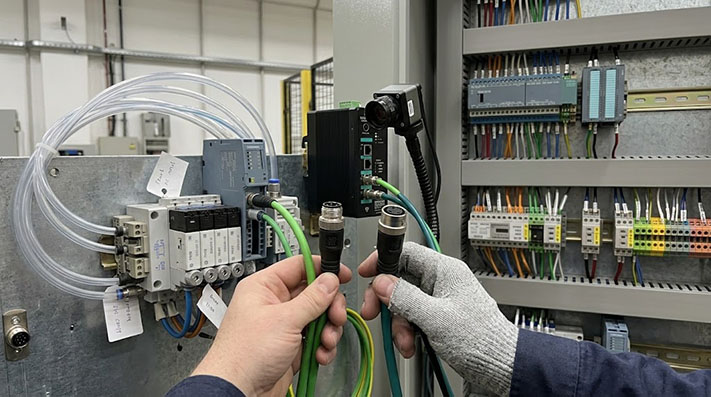
When specifying cables for a Profinet system, a common point of confusion is choosing between 4-pin M12 D-Code and 8-pin M12 X-Code connectors[cite: 12]. While both are used for Industrial Ethernet, selecting the wrong one can lead to performance bottlenecks or simple physical incompatibility[cite: 12]. The choice depends entirely on the data rate required by your specific Profinet device[cite: 12].
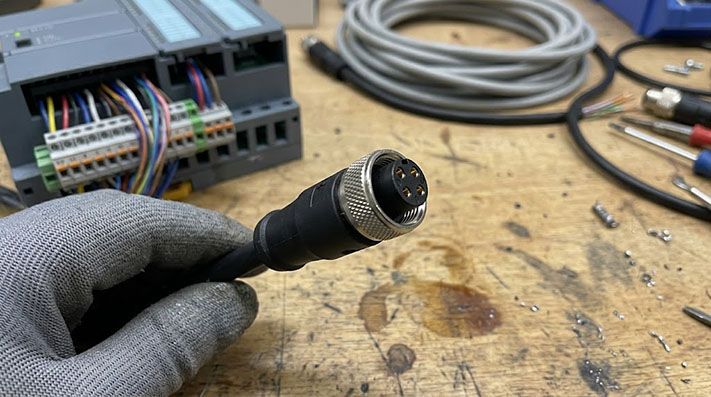
For the majority of Profinet applications, particularly those involving standard sensors, I/O blocks, and actuators, the M12 D-Code 4-pin cable is the correct and standard choice[cite: 12]. These devices operate on Profinet RT (Real-Time) at 100 Mbps, a data rate for which the D-Code connector was designed[cite: 12].
Profinet Cable Needs: Device Speed is the Deciding Factor
The Profinet standard itself doesn't mandate a single cable type[cite: 12]. Instead, the cable requirement is dictated by the Ethernet port on the hardware you are connecting[cite: 12].
- 100 Mbps Devices (Fast Ethernet): Most Profinet field devices like remote I/O, pneumatic valve manifolds, and standard sensors are built with 10/100 Mbps ports[cite: 12]. These ports use two wire pairs (4 wires) for communication[cite: 12]. The M12 D-Code connector is the industry-standard interface for these 4-wire, 100 Mbps connections[cite: 12].
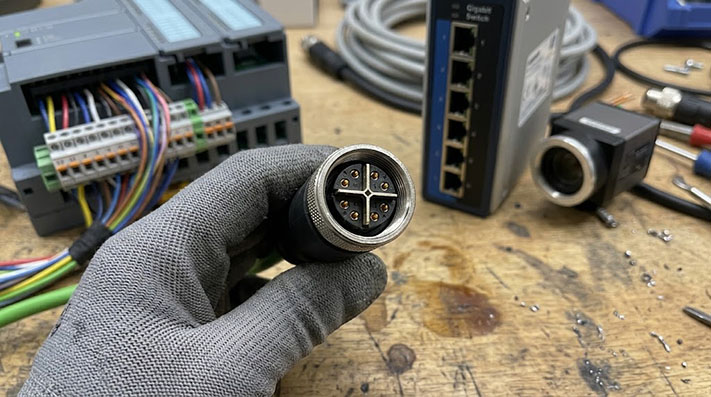
- 1 Gbps Devices (Gigabit Ethernet): High-bandwidth devices like machine vision cameras, network backbone switches, or advanced motion controllers may require Gigabit Ethernet speeds to handle large data volumes[cite: 12]. These devices have 1 Gbps ports that require four wire pairs (8 wires)[cite: 12]. The M12 X-Code connector is designed for these 8-wire, high-speed applications[cite: 12].
Using an 8-pin X-Code cable for a 4-pin D-Code device is not a "future-proofing" strategy; it's a physical mismatch[cite: 12]. The connectors have different keying patterns and cannot be mated[cite: 12].
The Role of M12 D-Code in Profinet Conformance Class A and B
Profinet organizes devices into Conformance Classes (CC) based on their function and network requirements[cite: 12]. The M12 D-Code finds its home in the two most common classes[cite: 12].
 [cite: 12]
Conformance Class A (CC-A)
CC-A is for basic automation tasks where real-time control is needed but without the stringent timing of advanced motion control[cite: 12]. This includes communication with standard I/O devices[cite: 12]. Since these applications run on Profinet RT at 100 Mbps, M12 D-Code cables are the standard specification[cite: 12].
Conformance Class B (CC-B)
CC-B builds on CC-A by adding requirements for network diagnostics and topology detection, which is common in more complex plant-wide networks[cite: 12]. Even with these added network management features, the underlying data rate for most field devices remains 100 Mbps[cite: 12]. Therefore, M12 D-Code cables remain the appropriate choice for connecting CC-B devices like sensors and actuators[cite: 12].
Profinet Conformance Classes (CC-A / CC-B / CC-C) Real-Time Performance & Physical Layer Limits
Mapping Profinet network functionality to physical interface standards ensures deterministic communication across distributed factory automation cells:
| Profinet Conformance Class | Typical Real-Time Cycle Time | Supported Network Diagnostics & Topology | Recommended M12 Interface Standard | Primary Target Automation Application |
|---|---|---|---|---|
| Conformance Class A (CC-A) | 2 ms to 10 ms (Standard RT) | Basic cyclical real-time I/O data | M12 D-Code (4-Pin Fast Ethernet) | Standalone machines, remote I/O blocks, pneumatic valves |
| Conformance Class B (CC-B) | 1 ms to 5 ms (Enhanced RT) | SNMP, LLDP, ring redundancy (MRP) | M12 D-Code (4-Pin Fast Ethernet) | Plant-wide factory automation networks and medium-scale cells |
| Conformance Class C (CC-C) | < 250 microseconds (IRT) | Hardware-level clock synchronization | M12 D-Code or X-Code (Device Dependent) | High-speed synchronized multi-axis motion control (Servo/Robotics) |
When Do You Need to Specify M12 X-Code?
You only need to specify an 8-pin M12 X-Code cable for a Profinet application when the device explicitly requires Gigabit Ethernet speed[cite: 12].
Common scenarios for M12 X-Code include[cite: 12]:
- Connecting a high-resolution machine vision camera[cite: 12].
- Linking two industrial Ethernet switches to form a high-speed network backbone[cite: 12].
- Connecting to a high-performance industrial PC or controller with a 1 Gbps port[cite: 12].
Even in systems with Conformance Class C (CC-C) for high-performance motion control (IRT - Isochronous Real-Time), the choice is still device-dependent[cite: 12]. While the timing is more precise, many IRT devices still operate at 100 Mbps and use D-Code connectors[cite: 12]. Always verify the hardware specification[cite: 12].
 [cite: 12]
Quick Comparison: D-Code vs. X-Code for Profinet
| Feature | M12 D-Code (4-Pin) | M12 X-Code (8-Pin) |
|---|---|---|
| Typical Speed | 100 Mbps (Fast Ethernet)[cite: 12] | 1 Gbps to 10 Gbps[cite: 12] |
| Common Profinet Use | Profinet RT (CC-A, CC-B)[cite: 12] | High-speed devices, network backbones[cite: 12] |
| Wires Required | 4 wires (2 pairs)[cite: 12] | 8 wires (4 pairs)[cite: 12] |
| Physical Keying | Single flat key[cite: 12] | Shielded cross-key[cite: 12] |
| Typical Devices | Sensors, actuators, remote I/O[cite: 12] | Vision cameras, network switches, PCs[cite: 12] |
Profinet Fast Ethernet (100 BASE-TX) High-Frequency Electrical Limits (at 100 MHz)
When deploying M12 D-Code assemblies for Profinet RT networks, physical layer transmission parameters must satisfy these stringent thresholds:
| Electrical Certification Parameter | Minimum / Maximum Allowable Limit (at 100 MHz) | Engineering Significance & Failure Consequence | Testing Standard & Method |
|---|---|---|---|
| Insertion Loss (Attenuation) | Maximum 22.0 dB loss (per 100m channel) | Signal weakening over long runs; triggers Profinet frame drops. | TIA-568-C.2 / IEC 61156-5 |
| Near-End Crosstalk (NEXT) | Minimum 30.1 dB isolation | Signal bleeding between transmit and receive pairs. | IEC 60603-7 Modular Plug Spec |
| Return Loss (RL) Performance | Minimum 14.0 dB reflection margin | Impedance mismatches caused by poor D-Code pin crimping. | IEC 60335 / ISO/IEC 11801 |
| Differential Characteristic Impedance | 100 ohms ± 15% | Prevents internal signal reflection and jitter. | IEC 61156-5 Profinet Cabling Standard |
How to Confirm Your Profinet Cable Requirements Before Ordering
Profinet Application Environment: Jacket Material & Shielding Selection Matrix
Industrial routing conditions dictate the mechanical and electromagnetic specifications required for reliable Profinet field bus drops:
| Factory Routing Environment | Recommended Jacket Material | Shielding Topology Requirement | Min. Dynamic Bend Radius | Tested Drag Chain Flex Cycles |
|---|---|---|---|---|
| Static Cabinet / Cable Tray | PVC (Flame retardant) | SF/UTP (Overall Foil + Braid Shield) | 5 x Outer Diameter (OD) | N/A (Fixed Static Installation) |
| Standard Machine Frame / Gantry | PUR / PVC Hybrid | SF/UTP (Overall Foil + Braid Shield) | 7.5 x OD | Greater than 1,000,000 Cycles |
| High-Flex Drag Chain (Robotic Cell) | PUR (Polyurethane High-Flex) | SF/UTP (High-Coverage Tinned Braid) | 10 x OD | Greater than 5,000,000 to 10,000,000 Cycles |
| Food & Bev Washdown / Chemical | TPE / Special PUR Compound | Corrosion-Resistant Braid Shield | 12 x OD | Resists aggressive alkaline cleaning agents |
To prevent ordering errors and project delays, follow this simple verification process for every Profinet device in your Bill of Materials (BOM)[cite: 12].
- Check the Device Data Sheet: This is the most reliable source[cite: 12]. Look for the technical specifications of the Ethernet port[cite: 12]. It will state the speed, such as "10/100 BASE-T(X)" or "10/100/1000 BASE-T(X)"[cite: 12]. The first indicates a 100 Mbps port (use D-Code), while the second indicates a Gigabit port (use X-Code)[cite: 12].
- Inspect the Physical Connector: If you have the device on hand, look at the connector port[cite: 12]. The D-Code has a single, flat notch in the keying pattern[cite: 12]. The X-Code has a cross-shaped metal shield that separates the pin pairs[cite: 12]. The difference is unambiguous[cite: 12].
- Review the System Architecture: Consider where the cable is being used[cite: 12]. Is it connecting an endpoint device to a switch, or is it linking major pieces of network infrastructure[cite: 12]? Endpoint connections are overwhelmingly D-Code, while infrastructure links are more likely to be X-Code if high traffic is expected[cite: 12].
Getting Your Profinet Cable Specification Right
Choosing the correct industrial Ethernet cable is fundamental to a reliable Profinet network[cite: 12]. For the vast majority of sensor, actuator, and I/O connections in CC-A and CC-B systems, the M12 D-Code 4-pin cable assembly is the correct, cost-effective, and technically appropriate choice[cite: 12].
If you are creating a bill of materials for a new machine or sourcing replacement cables, confirming the data rate requirements of each device is the most important step[cite: 12]. If you are unsure, our team can help[cite: 12]. Provide us with your list of Profinet devices and application requirements, and we can assist in specifying the correct cable assemblies for your project[cite: 12].
<!--[googlesitekit-end-of-content]-->