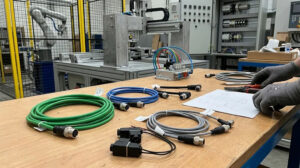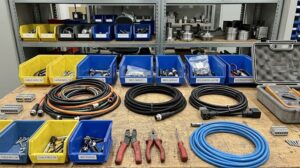
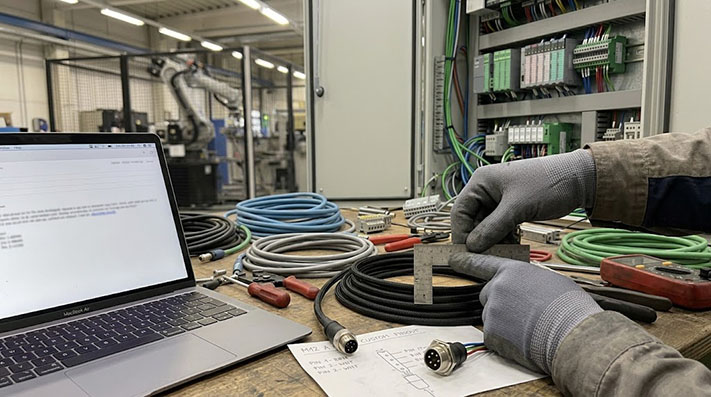
You have a new automation project, a machine repair, or a prototype on your bench. You need a specific industrial cable assembly, and you need a sample to test for fit and function. The next step is to contact a potential supplier, but what information do you actually need to provide in that first email? A vague request can lead to a long chain of clarification emails, delaying your project by days.
A clear, detailed request enables a supplier to give you a fast and accurate response, confirming if they have a suitable product, what it will cost, and how quickly they can get it to you.
The Minimum Viable Information for a Fast Response
If you provide nothing else, make sure your first email answers these five questions. This is the minimum information needed for any industrial cable supplier to understand your basic requirement.
- Connector A: What is on the first end?
- Connector B: What is on the other end? (Or is it a blunt cut?)
- Cable Length: How long does the assembly need to be?
- Application: Where and how will the cable be used?
- Quantity: Is this a one-off sample for a prototype, or a pre-production sample for a potential order of 1,000 units?
A request with only these details is a great start. A request without them often results in a reply that is just another list of questions.
From Vague to Actionable: A Before-and-After Example
Many initial sample requests are too brief to be useful. They create unnecessary work for both the engineer and the supplier.
The Ineffective Request:
Subject: M12 Cable Sample
Hi,
Do you have M12 cables? I need a sample for a project.
Thanks, Engineer
This email forces the supplier to reply with questions: What M12 coding? How many pins? Male or female? Straight or right-angle? What is on the other end? How long? What is the application? The project is now on hold, waiting for these answers.
The Effective Request:
Subject: Sample Request: M12 A-Code 5-Pin Male to Female Cable, 2-Meter
Hi,
I am looking for a sample of the following cable assembly for a new sensor integration project:
- Connector A: M12, A-Code, 5-Pin, Male, Straight*
- Connector B: M12, A-Code, 5-Pin, Female, Straight*
- Cable Length: 2 meters*
- Jacket: PUR, Shielded*
- Application: Robotic arm with continuous flexing. Will be exposed to cutting fluids.*
- Quantity: Sample (1 pc) for fit/flex test. Potential production volume is 250 pcs/year.*
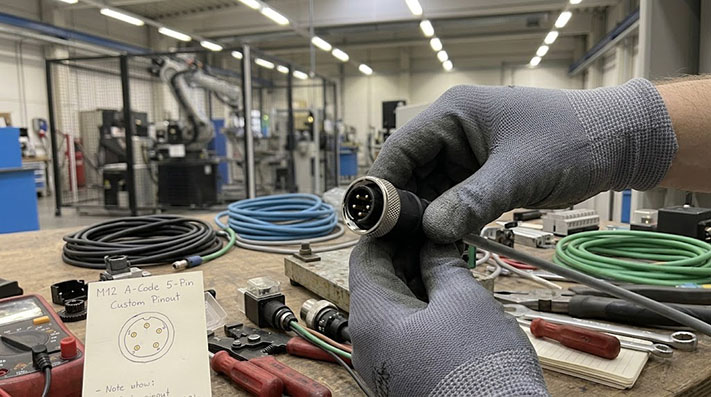
I have attached a photo of the mating panel connector and a basic pinout diagram.
Please let me know availability and cost for this sample.
Thanks, Engineer
This request provides a complete picture, allowing the supplier to immediately check stock, confirm technical suitability, and prepare a quote.
A Checklist for Your Next Sample Request
Use this as a template to build your email. Even if you don't know every detail, providing what you can is better than sending a generic inquiry.
1. Connector Specifications (for Each End)
This is the most critical part. Be as specific as possible.
- Connector Family: M12, M8, M23, Solenoid Valve (DIN Form A, B, C), etc.
- Coding: A-Code, B-Code, D-Code, X-Code (especially important for M12 Ethernet and signal).
- Pin Count: How many pins or positions does the connector have?
- Gender: Male (pins) or Female (sockets)?
- Orientation: Straight or Right-Angle?
Reference Table: Electrical Parameters to State in Your Request
When requesting custom cable assembly samples, state or pre-calculate these electrical parameters so the supplier quotes the correct internal wire gauge and shielding structure:
| Electrical Parameter | What to State in Your Request | Why It Matters | Verification Method |
|---|---|---|---|
| System Voltage | Nominal voltage, AC or DC, and the overvoltage category of the installation | A 24 V sensor line and a 400–600 V drive feed cannot share one insert or one conductor wall thickness | IEC 60664-1 — insulation coordination sets clearances; it does not issue a connector voltage rating |
| Continuous Current | Per-pin current at your ambient temperature, and how many cables run bundled | Drives conductor cross-section and the connector's temperature rise; the same insert derates very differently depending on bundling | IEC 60512-5-2 — current-temperature derating, test method |
| Characteristic Impedance | For Ethernet only: 100 Ω differential, and the data rate you need | 100 MHz-class and 500 MHz-class cables are not interchangeable, and impedance belongs to the finished assembly, not to the connector | TIA-568 series / ISO/IEC 11801 — cabling classes |
| Contact Resistance | The measured value on the assembly you are buying, and the limit your own end-of-line test applies | Rises with plating wear and mating cycles, so a catalogue number tells you little about a two-year-old assembly | IEC 60512-2-1 — contact resistance, test method |
| Insulation Resistance | The test voltage and the value your safety case requires | Depends on insert and jacket material and on humidity, not on the connector series alone | IEC 60512-3-1 — insulation resistance, test method |
How to use this table: state the parameter even when you are unsure of the exact figure — an approximate system voltage and a rough current are far more useful to a supplier than a blank line. The standards named here are the test and coordination methods behind each parameter, not limit values. IEC 60512 defines how contact and insulation resistance are measured; it does not set a pass threshold, and that threshold belongs in your own acceptance spec. For Ethernet runs, also say whether the link carries PoE or PoE+ power, because that adds a DC current requirement on top of the data pair.
2. Cable and Assembly Details
- Overall Length: Specify the unit (e.g., meters, feet, inches). Be clear if this is the end-to-end length including connectors.
- End B Configuration: Does it terminate in another connector, or is it a "pigtail" with flying leads (blunt cut)? If it's a pigtail, how long should the stripped and tinned portion be?
- Jacket Material (If Known): PVC is common for static applications. PUR is often preferred for flexibility, abrasion resistance, and oil resistance.
- Shielding: Is shielding required? This is typical for Ethernet (D-Code, X-Code) or applications in high-EMI environments.
3. Application and Quantity Context
This information helps the supplier understand if a standard product is sufficient or if a more robust custom solution is needed.
- Application Environment: Describe the machine and operating conditions. Key factors include:
- Static, flexing, or high-cycle drag chain use?
- Exposure to oils, chemicals, weld spatter, or washdown procedures?
- Indoor or outdoor installation?
Reference Table: Motion Profile and Conductor Design
Suppliers require precise motion dynamics to select appropriate conductor stranding profiles and outer jacket elasticity for your sample build:
| Motion Classification | Typical Conductor and Core Approach | What the Supplier Needs to Know | Failure Risk If Under-Specified |
|---|---|---|---|
| Static / Fixed Cabinet | Solid or standard stranded copper | The route is fixed after installation and does not move again | Sharp-edge pinching at cable entries |
| Occasional Flex / Catenary | Fine-stranded bare copper | How often the cable moves, and over what travel length | Conductor fatigue at the fixed clamp points |
| Continuous Drag Chain (High-Flex) | Extra-fine bundled strands with a central core element | Travel distance, speed, acceleration, and the chain bend radius | Core elongation and strand breakage near the connector |
| 3D Robotic Articulated Torsion | Torsional strain-relief core | Torsion angle per metre, and how many axes the cable follows | Braid breakage and pair separation |
Motion note: Bend radius, cycle count, and speed limits come from the cable construction and from the test regime the manufacturer used — travel length, acceleration, and whether the rig was a chain or a torsion test all change the number. Ask for the test standard and the cycle count behind any figure, and give the supplier your actual travel distance and cycle rate rather than a target service life.
Reference Table: Jacket Compatibility by Exposure
Specifying the exact chemical exposure in your initial sample request prevents jacket swelling, cracking, and premature field failures:
| Exposure Medium / Harsh Element | PVC Jacket | PUR Jacket | TPE Jacket | Primary Degradation Risk |
|---|---|---|---|---|
| Mineral Cutting Oils & Coolants | Poor (swells and hardens) | Good to excellent, low swell | Good to very good | Plasticiser leaching out of the polymer matrix |
| Synthetic Lubricants & Esters | Poor (cracks over time) | Good to very good | Good chemical stability | Ester bond hydrolysis and softening |
| Caustic Washdown (Food and Beverage) | Moderate (surface wear) | Fair | Good to excellent against alkaline attack | Alkaline surface attack |
| UV Radiation and Outdoor Ozone | Moderate (surface crazing) | Good | Good to excellent, weather-resistant | Photo-oxidation breaking molecular bonds |
| Weld Spatter and Radiant Heat | Fails (melts) | Fair; tack-free variants exist | Good to excellent (cross-linked TPE) | Direct thermal melting or burn-through |
Compatibility note: These are relative tendencies for the three common jacket families, not measured values for a specific compound. Formulation, hardness, and additive package change the outcome — a plasticiser-heavy PVC and a low-migration PVC behave differently against the same cutting oil. For anything critical, ask for an immersion test on the exact compound you will buy.
- Quantity Intent:
- Prototype / Repair: "I need one piece to test fit on a prototype machine."
- Pre-Production: "I need 2-3 samples to validate for a new product line with a potential volume of 500 units." This context is important. A one-off sample for a repair might be built by hand in a lab, while a pre-production sample for a high-volume product may require setting up production tooling. This affects cost and lead time.
4. Supporting Documents: What Helps Most
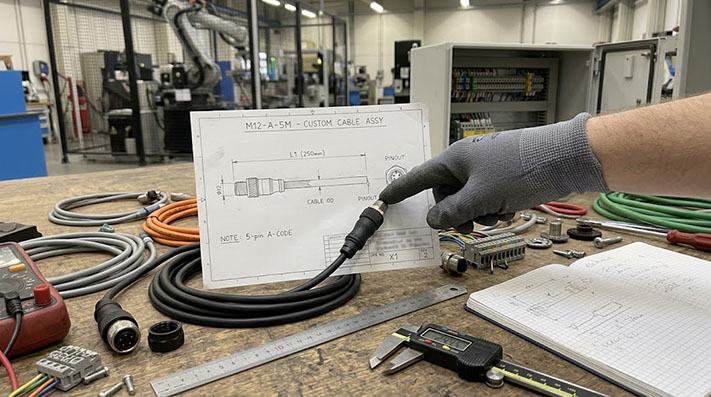
A picture is truly worth a thousand words.
- Photo of an Existing Cable or Mating Connector: This is the most helpful attachment. It can instantly clarify coding, pinout, and physical constraints.
- Datasheet or Part Number of an Existing Product: If you are trying to find an alternative for a part from another supplier, providing their part number or datasheet is a great starting point for a technical review.
- Simple Drawing or Sketch: A formal CAD drawing is great, but a hand sketch showing the pinout and lengths is often all that is needed for an initial quote.
Get the Right Sample, Faster
Taking a few extra minutes to gather these details before you hit "send" will save you days of back-and-forth emails. A well-defined request demonstrates a clear project need and allows a supplier like Tianlun Interconnect to focus on what matters: finding the right solution for your application.
At Tianlun Interconnect, we specialize in industrial connectors and custom cable assemblies for automation. When you send us a request with clear specifications, drawings, or photos, our team can quickly evaluate your needs and propose a solution.
Use the checklist above to structure your next RFQ. A complete request helps us provide an accurate quote and realistic lead time for your prototype, repair, or production-run cable assemblies.
<!--[googlesitekit-end-of-content]-->