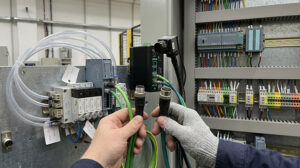

Choosing the right cable for an industrial machine involves more than just matching the connector and pinout. The cable's outer jacket is the first line of defense against heat, chemicals, abrasion, and constant motion. Selecting the wrong jacket material can lead to premature cable failure, unplanned downtime, and maintenance costs that far exceed the initial savings of a cheaper cable.
For an OEM designer or MRO engineer, the choice often comes down to three common thermoplastic materials: PVC, PUR, and TPE. Each has a distinct profile of cost, durability, and environmental resistance. Understanding their differences is key to specifying a reliable and cost-effective cable assembly.
A Direct Comparison: PVC vs. PUR vs. TPE
The best material depends entirely on the application's environment and mechanical demands. Polyvinyl Chloride (PVC) is a general-purpose, cost-effective option for static applications. Polyurethane (PUR) is the industrial workhorse, prized for its mechanical toughness in motion-heavy and oily environments. Thermoplastic Elastomer (TPE) is a high-performance option that offers a wide temperature range and excellent chemical resistance.
Here is a high-level comparison of their core properties:
| Feature | PVC (Polyvinyl Chloride) | PUR (Polyurethane) | TPE (Thermoplastic Elastomer) |
|---|---|---|---|
| Primary Strength | Low cost | Mechanical toughness & abrasion resistance | Wide temperature range & chemical resistance |
| Flexibility | Good for static or infrequent movement | Excellent for continuous flex and torsion | Very good to excellent, rubber-like feel |
| Abrasion Resistance | Fair to good | Excellent | Good to very good |
| Oil Resistance | Limited; varies by compound | Excellent, especially against mineral oils | Very good; often resists more aggressive chemicals |
| Temperature Range | Fair; can become brittle in cold | Good; remains flexible in moderate cold | Excellent; maintains properties in extreme cold and heat |
| Relative Cost | Low | Medium | High |
| Common Use Case | Fixed sensor runs, control cabinet wiring | Robotics, drag chains, CNC machines | Outdoor use, food & beverage, freezer applications |
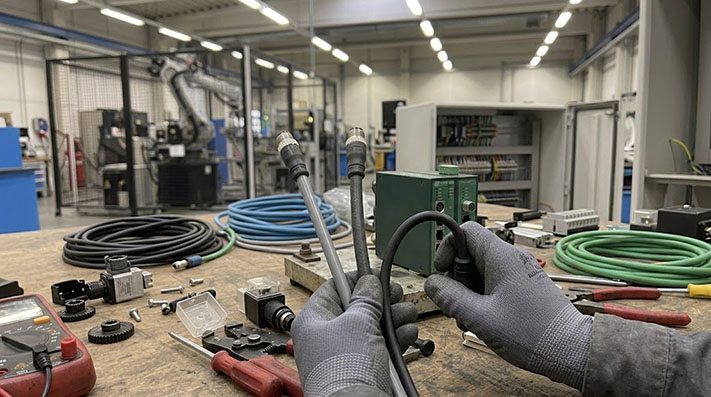
Quantitative Polymer Matrix: Mechanical & Thermal Specifications
For rigorous engineering selection, the physical performance envelope of each jacket compound is defined by strict laboratory testing standards:
| Physical & Mechanical Parameter | Standard PVC Compound | Polyether-Based PUR Compound | Thermoplastic Elastomer (TPE) | Testing Standard / Method |
|---|---|---|---|---|
| Tensile Strength | 12.5–15.0 MPa | 35.0–45.0 MPa (ultra-high) | 18.0–25.0 MPa | ASTM D638 / ISO 527 |
| Ultimate Elongation at Break | 250%–300% | 450%–600% | 350%–500% | ASTM D638 / IEC 60811 |
| Taber Abrasion Resistance | High weight loss (> 150 mg) | Minimal loss (< 25 mg) | Moderate loss (40–70 mg) | ISO 9352 / ASTM D4060 (H-18 wheel) |
| Continuous Operating Temp. | -15°C to +70°C | -30°C to +90°C | -50°C to +125°C | UL 1581 / material datasheet |
| Flame Retardancy Rating | UL 94 V-0 / VW-1 | UL 94 V-2 / FT1 | UL 94 HB to V-0 variants | UL 1581 / UL 94 |
| Halogen Content / Toxicity | Typically halogenated (PVC) | Halogen-free options available | Zero halogen (LSZH standard) | IEC 60754-1 / -2 |
Tensile, elongation, and abrasion figures are typical ranges for cable-grade compounds and shift with formulation and hardness. Flame ratings apply to the finished cable construction, not to the raw compound. Confirm the exact grade and the test report with your supplier.
When Standard PVC Is the Right Choice
PVC is the most widely used cable jacket material for good reason: it provides adequate protection in controlled environments at a very low cost. For many standard automation tasks, a PVC-jacketed cable is a perfectly reliable choice.
Choose PVC for:
- Static Applications: Ideal for wiring inside control panels, connecting stationary sensors, or runs in cable trays where the cable will not be moved after installation.
- Cost-Sensitive Projects: When budgets are tight and the application environment is mild (room temperature, no harsh chemicals, no movement), PVC delivers the necessary electrical protection without extra cost.
However, it's important to know its limits. Standard PVC can become stiff and brittle when exposed to sub-zero temperatures. It can also degrade when in long-term contact with certain industrial oils and is not typically recommended for applications with constant flexing or torsional stress.
Stepping Up to PUR for Motion, Abrasion, and Oils
For robotics, machine tools, and material handling systems, Polyurethane (PUR) is often the default choice. Its primary advantage is exceptional mechanical strength. PUR jackets are extremely difficult to cut, tear, or abrade, making them ideal for environments where cables are dragged, flexed, or exposed to moving machine parts.
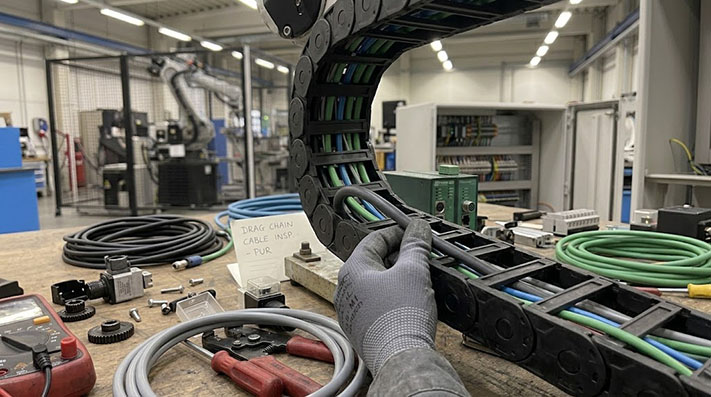
Key benefits of PUR include:
- High Flex Life: PUR has excellent "memory," meaning it returns to its original shape after being bent or stretched. This makes it a top performer in drag chain (energy chain) and torsional robotics applications.
- Superior Abrasion Resistance: The material is tough enough to withstand rubbing against metal shavings, concrete floors, and machine components.
- Excellent Oil Resistance: It stands up well to the mineral oils, coolants, and cutting fluids common in CNC machining and metalworking environments.
Some high-flexibility cables, often designated as TRVV, use specially formulated PVC to compete in motion applications. While these can be effective, PUR generally offers a higher level of combined resistance to tearing, torsion, and chemical exposure, making it a more robust solution for the most demanding dynamic applications.
Jacket and Construction by Motion Profile
For continuous motion environments such as automated axes and articulated robots, the mechanical fatigue limit of the jacket and inner core is critical:
| Motion Profile / Application Type | Typical Jacket and Construction Approach | Failure Risk Mode |
|---|---|---|
| Static / Fixed Installation | PVC, solid or coarse-stranded conductor | Low stress; risk comes from sharp pinch points |
| Standard Cable Tray / Catenary | PUR or high-flex PVC, stranded conductor | Moderate fatigue; watch for outer jacket wrinkling |
| High-Flex Drag Chain | PUR, fine-stranded conductor | Core elongation and broken strands near the end fittings |
| 3D Robotic Torsional Arm | TPE or PUR with a dedicated center core element | Braid rupture and pair unwinding |
Bend radius, cycle count, and twist limits belong to a specific cable construction, not to the jacket compound alone. Ask for the test setup behind any figure quoted — travel, speed, acceleration, torsion angle — and compare it with your actual motion profile.
TPE: The Problem-Solver for Extreme Conditions
Thermoplastic Elastomer (TPE) is a class of materials that blends the properties of plastic and rubber. TPE-jacketed cables are specified when neither PVC nor PUR can meet a specific environmental challenge, most often related to temperature or chemicals.
Consider TPE when your application involves:
- Extreme Temperatures: TPE maintains excellent flexibility in deep-freeze environments and can also withstand higher operating temperatures than most PVC or PUR compounds. This makes it suitable for freezer rooms, foundries, or welding cells.
- Aggressive Chemical Exposure: While PUR is great with oils, TPE often provides superior resistance to a wider range of chemicals, including many acids, bases, and aggressive cleaning agents used in food and beverage washdown processes.
- Outdoor Applications: Many TPE formulations have excellent resistance to UV radiation and ozone, preventing the jacket from cracking or degrading when exposed to direct sunlight.
TPE is also often halogen-free, which is a requirement in certain industries (like transportation) to reduce the emission of toxic smoke in the event of a fire.
Chemical Resistance, Coolant Immersion & Environmental Compatibility
Industrial fluids and aggressive washdown protocols break down polymer chains over time. The resistance rating across compounds is structured as follows:
| Exposure Medium / Fluid Type | PVC Compound Behavior | PUR Compound Behavior | TPE Compound Behavior | Primary Chemical Breakdown Process |
|---|---|---|---|---|
| Mineral Oils & Hydraulic Fluids | Moderate Swell & Hardening | Excellent (Zero Degradation) | Good to Very Good | Plasticizer extraction / Polymer chain softening |
| Synthetic Ester Lubricants | Poor (Rapid Degradation) | Good to Very Good | Superior Chemical Stability | Ester bond hydrolysis / Swelling & cracking |
| Caustic Washdown (Food Processing) | Poor (Surface Whitening) | Fair | Excellent (Resists Cleaners) | Alkaline chemical attack on polymer backbone |
| UV Radiation & Ozone (Outdoor) | Moderate (Surface Cracking) | Good | Superior (Weatherproof) | Photo-oxidation breaking molecular bonds |
Getting the Right Cable for Your Machine
Specifying a cable assembly by jacket material alone is a good start, but providing detailed environmental and mechanical requirements is better. When preparing a Request for Quotation (RFQ), a clear description of the operating conditions helps your supplier recommend or build the most reliable and cost-effective assembly.
Before you send your next RFQ, gather the following information:
- Motion Type: Will the cable be static, subject to occasional flexing, installed in a continuous-flex drag chain, or twisted by a robotic arm?
- Temperature Range: What are the minimum and maximum ambient temperatures the cable will experience during operation?
- Chemical Exposure: List any specific oils, solvents, coolants, or cleaning agents that will come into contact with the cable jacket?
- Mechanical Stress: Note any risk of abrasion, crushing, or high tensile loads?
- Required Standards: Are there any specific industry or regional standards (e.g., for flame retardancy, halogen content) that the cable must meet?
Not sure which jacket material best fits your specific environment and budget? The most effective path is to provide your application details to a knowledgeable supplier. By outlining the motion, temperature, and chemical challenges, you can get a cable assembly matched precisely to your machine's needs. If you have a drawing, a sample of a previous cable, or an existing part number, including it can significantly speed up the process.
<!--[googlesitekit-end-of-content]-->